The archer and the centaur
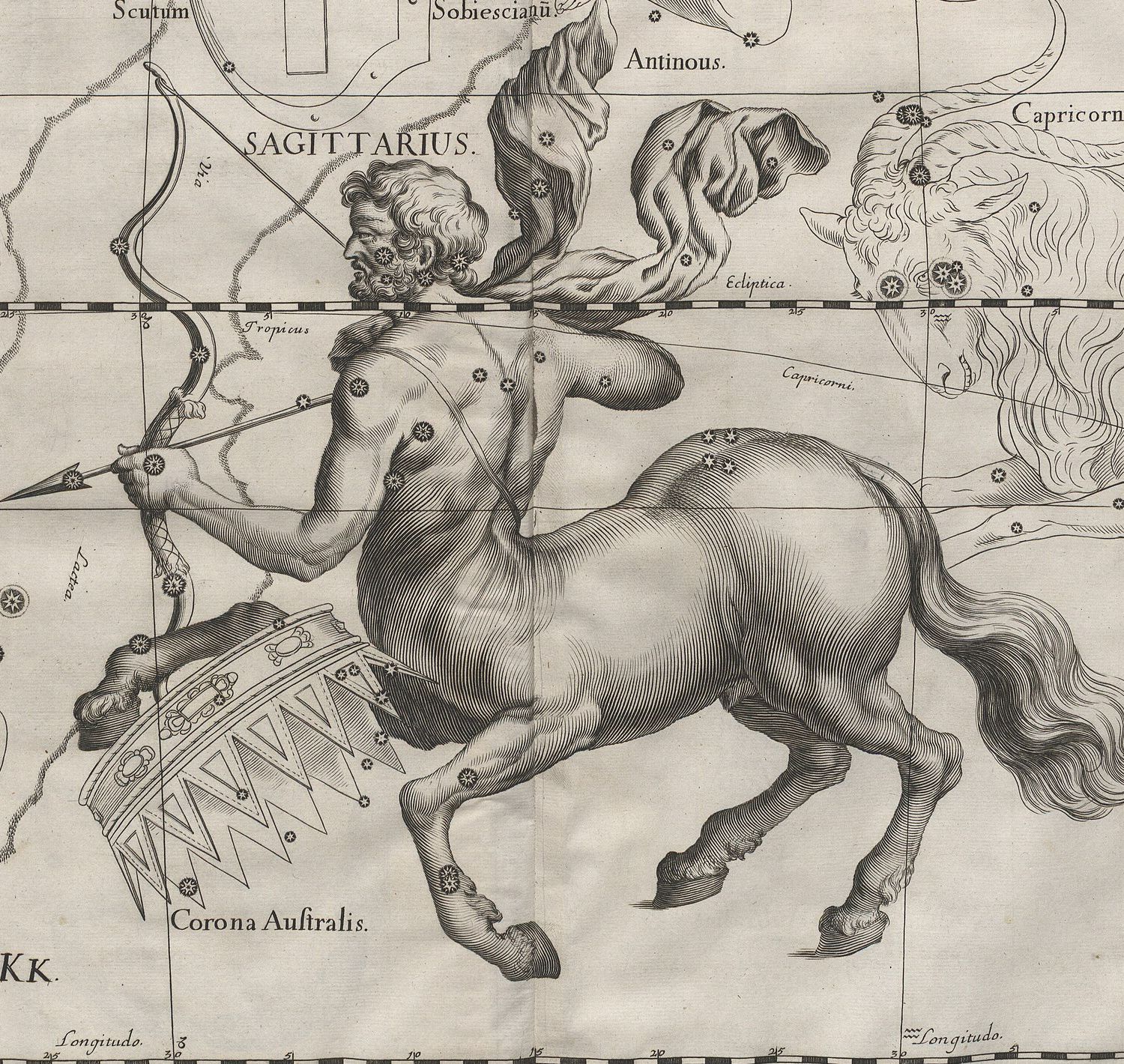
Sagittarius is drawn as a centaur, but who the archer is has never been settled. Eratosthenes saw Crotus, a satyr and son of Pan who invented archery, placed in the sky by Zeus at the Muses’ request.
Others recognise the centaur Chiron, Jason’s tutor; one tradition even says Chiron devised Sagittarius and Centaurus to guide the Argonauts.
The great forefather
The Sumerian name Pabilsag combines ‘elder paternal kinsman’ and ‘chief’: it can be translated as ‘the forefather’. The Babylonians identified him with the god Nergal, a centaur-like archer.
In classical antiquity the Sun stood in Capricornus at the December solstice; today it is in Sagittarius.
The real constellation
The centre of the Milky Way lies in the western part of Sagittarius, near Sagittarius A*, associated with a supermassive black hole of about 2.6 million solar masses. Eight stars draw the Teapot there: Delta, Epsilon, Zeta and Phi for the body, Lambda for the lid, Gamma for the spout, Sigma and Tau for the handle.
From Belgium the constellation stays very low: Kaus Australis rises no higher than 5 degrees above the Brussels horizon and is highest around 10 pm in late August. In 2026 the Sun stands in front of Sagittarius until 20 January, then again from 18 December.
Its stars
Kaus Australis
Magnitude 1.85, about 143 light years away: the brightest star in the constellation.
Nunki
Magnitude 2.08, about 260 light years away.
Ascella
Magnitude 2.61. A double star.
The Lagoon Nebula
Integrated magnitude 3.0, about 5,000 light years away.
In art and history
The archer has worn several faces, but always aimed at something.
- BabylonPabilsag, ‘the forefather’, identified with the archer god Nergal.
- AntiquityPtolemy lists Sagittarius among the 48 constellations of his catalogue, in the 2nd century.
- Scientific atlasesIn 1690 Hevelius engraved a galloping centaur drawing his bow, cloak flying, above Corona Australis.
