The myth of Orion
The Scorpion enters Greek mythology for one reason only: to kill Orion. The hunter had boasted he would kill every animal on Earth; the Earth sent a giant scorpion against him, and Zeus, at the prayer of Artemis and Leto, raised both enemies to the sky. In another version Apollo sends the creature.
Ever since, Orion flees every summer when the Scorpion arrives: the two constellations are never high in the sky at the same time. The full story of Orion and the Scorpion.
When Scorpius rises in the east, Orion sets in the west.
From claws to Libra
Scorpius used to be bigger. The Greeks called the stars we now place in Libra ‘the claws of the Scorpion’; the split came in Greek or Roman times.
The Arabic name of Libra’s brightest star, Zubeneschamali, still means ‘the northern claw’.
The real constellation
Scorpius lies south of the ecliptic, in one of the richest regions of the Milky Way. It is one of the few constellations that really looks like its name: a fan-shaped head, a red heart, Antares, and a long curling tail.
From Belgium you never see it whole. On June and July evenings Antares climbs barely 13 degrees above the southern horizon, and the tip of the tail stays lost in the haze, when it doesn’t simply remain below the horizon.
In 2026 the Sun is in front of Scorpius only from 23 to 30 November, then crosses Ophiuchus until 18 December. The sign, meanwhile, covers a full month from 23 October: that gap is the work of precession.
Its stars
Antares
Magnitude around 1, about 550 light years away. The Greek name means roughly ‘rival of Ares’, because of its red colour. A supergiant with a radius about 680 times the Sun’s.
Shaula
‘The raised tail’. It marks the sting, about 570 light years away, almost invisible from our latitudes.
Acrab
‘The scorpion’, about 470 light years away. A multiple star.
Dschubba
‘The forehead’. In July 2000 it brightened within weeks from magnitude 2.3 to 1.9, and has varied ever since.
Ptolemy’s Cluster
Easily seen with the naked eye near the sting, about 980 light years away. Ptolemy recorded it in 130 as a nebula.
In art and history
Few figures in the sky have such a long pedigree. The scorpion is already a constellation in Babylon, long before it becomes a sign.
- BabylonThe Babylonians called it MUL.GIR.TAB, ‘the scorpion’, which can also be read as ‘the creature with a burning sting’.
- Ptolemaic EgyptOn the Dendera zodiac, the ceiling of a chapel in the temple of Hathor dated to about 50 BC and now in the Louvre, the Scorpion keeps its Graeco-Roman form.
- GothicIn the Très Riches Heures du duc de Berry, at the Musée Condé in Chantilly, each calendar month sits under a half-circle showing the Sun’s chariot and the signs of the zodiac.
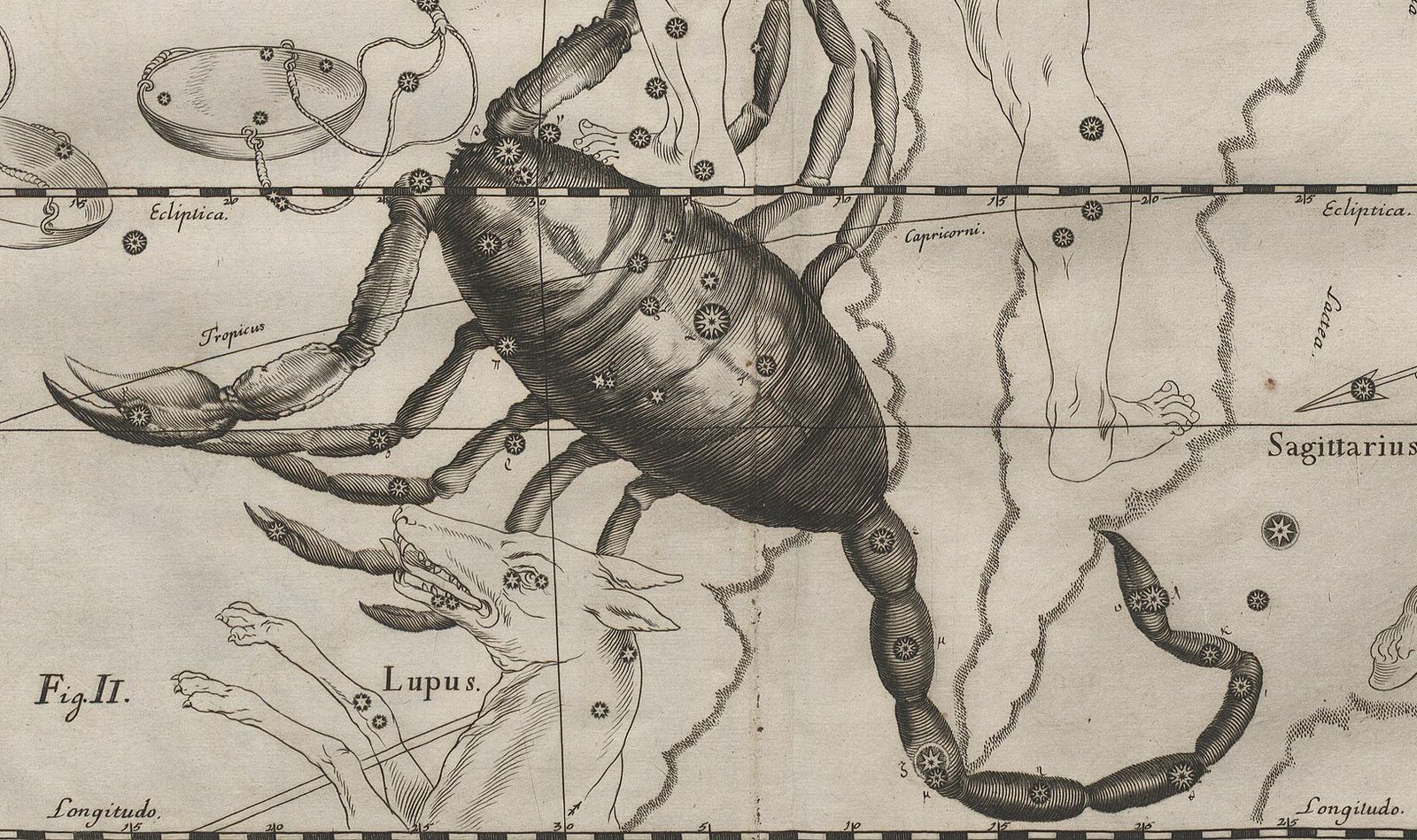
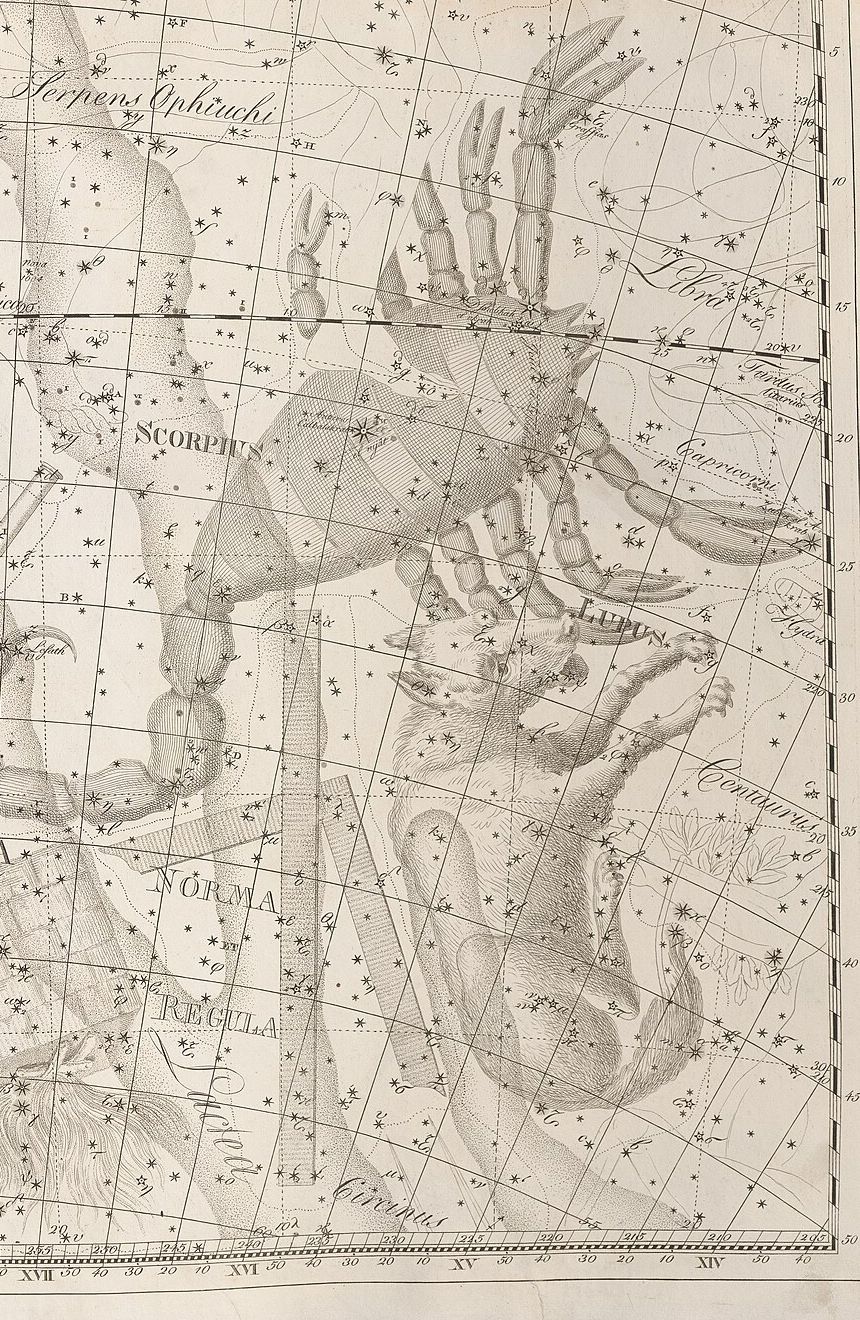
- Scientific atlasesHevelius in 1690, then Bode in 1801, engraved the creature on charts where every star is measured.
