Skip to content
the zodiac

Week of 19 to 25 October 2026

Scorpio

23 October to 22 November 2026

The Sun enters the sign on at . Until then, it finishes its passage through Libra.

Read about Scorpio

Brightest star in the constellation: Antares

The real sky, 19 to 25 October

The papers say Libra, then Scorpio. Look up, and the Sun is standing in front of the stars of Virgo. Both statements are true; they simply aren’t talking about the same thing.

Position of the Sun from 19 to 25 October 2026 Top band: the signs, cut into equal parts of 30 degrees. The Sun moves from the end of Libra to the start of Scorpio. Bottom band: the constellations with the boundaries set in 1930. There, the Sun is in front of Virgo. Signs, twelve equal parts of 30° Virgo Libra Scorpio Sagittarius Capric. Constellations, 1930 boundaries Leo Virgo Libra Sco. Ophiuchus Sagittarius The Sun this week
Ecliptic longitude from 160° to 280°. The Sun moves about one degree a day. It will not reach the constellation Libra until 31 October, nor Scorpius until 23 November, and stays there less than a week before entering Ophiuchus on 30 November.
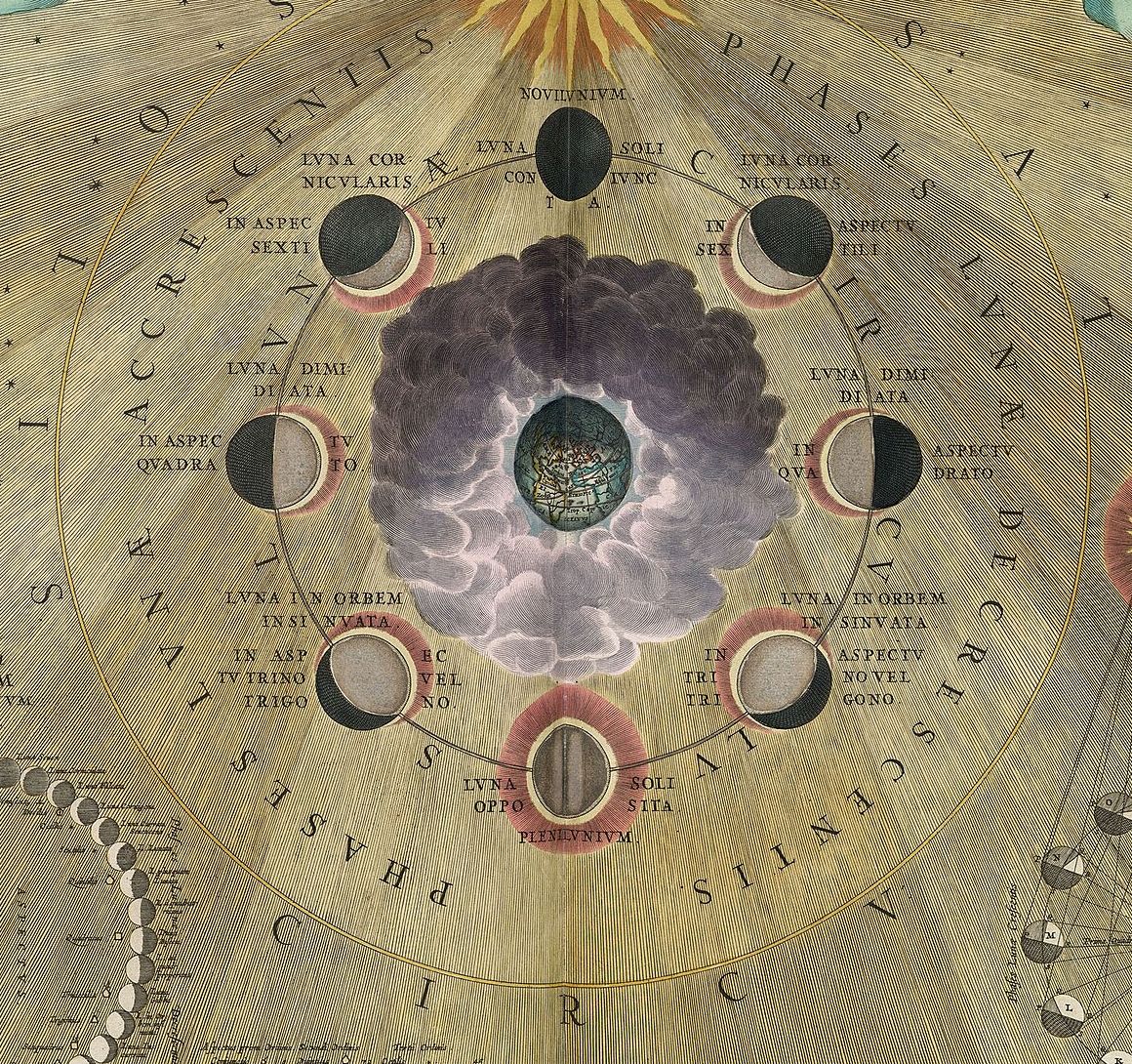
Hand-coloured 17th-century engraving: the phases of the Moon arranged in a circle around the Earth, lit by the Sun at the top.

The Moon is waxing

Past first quarter, it moves a little further east each evening, through the stars of Capricornus, Aquarius and Pisces, on its way to full moon.

First quarter
,
Full moon
,

Andreas Cellarius, Harmonia Macrocosmica, 1661, plate of the lunar phases (detail).

Saturn, all night long

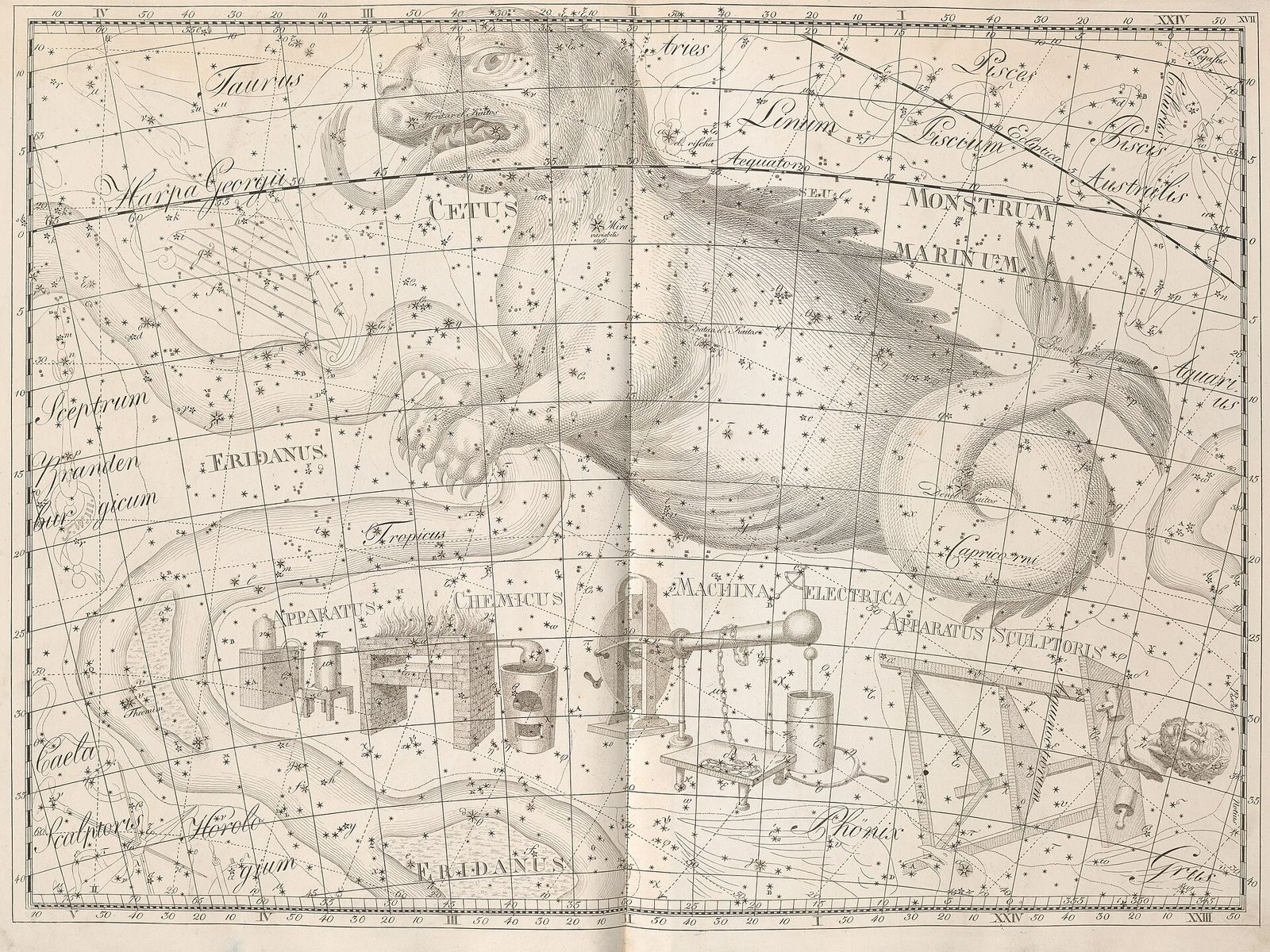
Two weeks after opposition on 4 October, Saturn rises around and doesn’t set until about . It lies outside the classical zodiac, in the constellation Cetus, just south of Pisces.

Engraving from 1801: Cetus, a sea monster with a dog’s head and a coiled tail, amid a grid of coordinates and stars.
Johann Elert Bode, Uranographia, 1801, Cetus, the Whale.

Jupiter and Mars, after midnight

Mars rises around in the constellation Cancer, Jupiter around in Leo. At magnitude −2, Jupiter outshines every star in the night sky.

Out of sight this week

  • Venus passes between the Earth and the Sun on at . This is inferior conjunction: the planet is lost in the glare of daylight.
  • Mercury sets less than half an hour after the Sun. On 24 October it reaches a stationary point and then seems to move backwards, a perspective effect caused by the Earth’s own motion.

The Orionids

This meteor shower peaks every year around 21 October. The meteors are dust left behind by Halley’s Comet, hitting the atmosphere at about 66 km per second. On the night of 21 to 22 October the Moon sets around , so the last hours before dawn will be the darkest.

This week’s horoscope

Read it for pleasure, not for prophecy.

Twelve short pieces, written for fun. They start from this week’s real sky and draw no conclusions whatsoever about your life: the stars decide nothing here.

20 March to 20 April

Mars, your ruler by tradition, rises at around one in the morning. Red, slightly ahead of everyone, up while the rest are asleep: you may know the type. Wave if you happen to be awake. If not, it won’t take offence.

20 April to 21 May

On paper, Monday’s full moon falls in your sign at in the morning. Not a Taurus hour. Admire it later over breakfast, with coffee, which remains the most sensible way to contemplate a celestial body.

21 May to 21 June

Mercury stops on the 24th, then appears to reverse. Pure optical illusion: the Earth is simply overtaking it. Reread your messages before sending them anyway. Not out of superstition, out of style.

21 June to 22 July

Mars is camping in your constellation, the real one, made of stars. A loud red visitor for the most retiring sign of all. Leave it on the doormat and watch it through the window at around three. Nobody will blame you.

22 July to 23 August

Jupiter is crossing your stars and outshining every one of them. You find this perfectly normal. So, by now, do the other eleven signs. Enjoy the show before dawn; at that hour there isn’t even an audience to acknowledge.

23 August to 23 September

The Sun is still in front of your stars, not the ones the papers mention. So you were right all along, as usual. Keep it to yourself: a Virgo who is quietly right still gets invited.

23 September to 23 October

On Friday at , the Sun leaves your sign. It will be back next year, on more or less the same day. Hand over the keys gracefully, take a last look round and leave Scorpio a kind note on the table.

23 October to 22 November

Your season opens late on Friday morning. In the real sky, the Sun won’t reach your stars until 23 November, and then for less than a week. You know how to wait. Rumour has it that’s your speciality.

22 November to 21 December

The Orionids streak in at 66 km per second. An archer can appreciate a well-loosed shot. Wait for the Moon to set, around half past three on Wednesday night, and count: it’s the only bet worth placing this week.

21 December to 20 January

The Moon crosses the stars of Capricornus on Monday and Tuesday evening, then moves on. Arrive, take stock, leave without a fuss: you’ll recognise the method. It’s yours.

20 January to 18 February

Saturn, your ancient ruler, is visible all night. Yet it has wandered out of the zodiac into the constellation Cetus. A god of time colouring outside the lines: you could hardly ask for a better role model.

18 February to 20 March

The Moon grows rounder in your stars on Friday, Saturday and Sunday. If you plan to sleep, draw the curtains. If you plan to dream, leave them open. It won’t change the sky. It might change your morning.

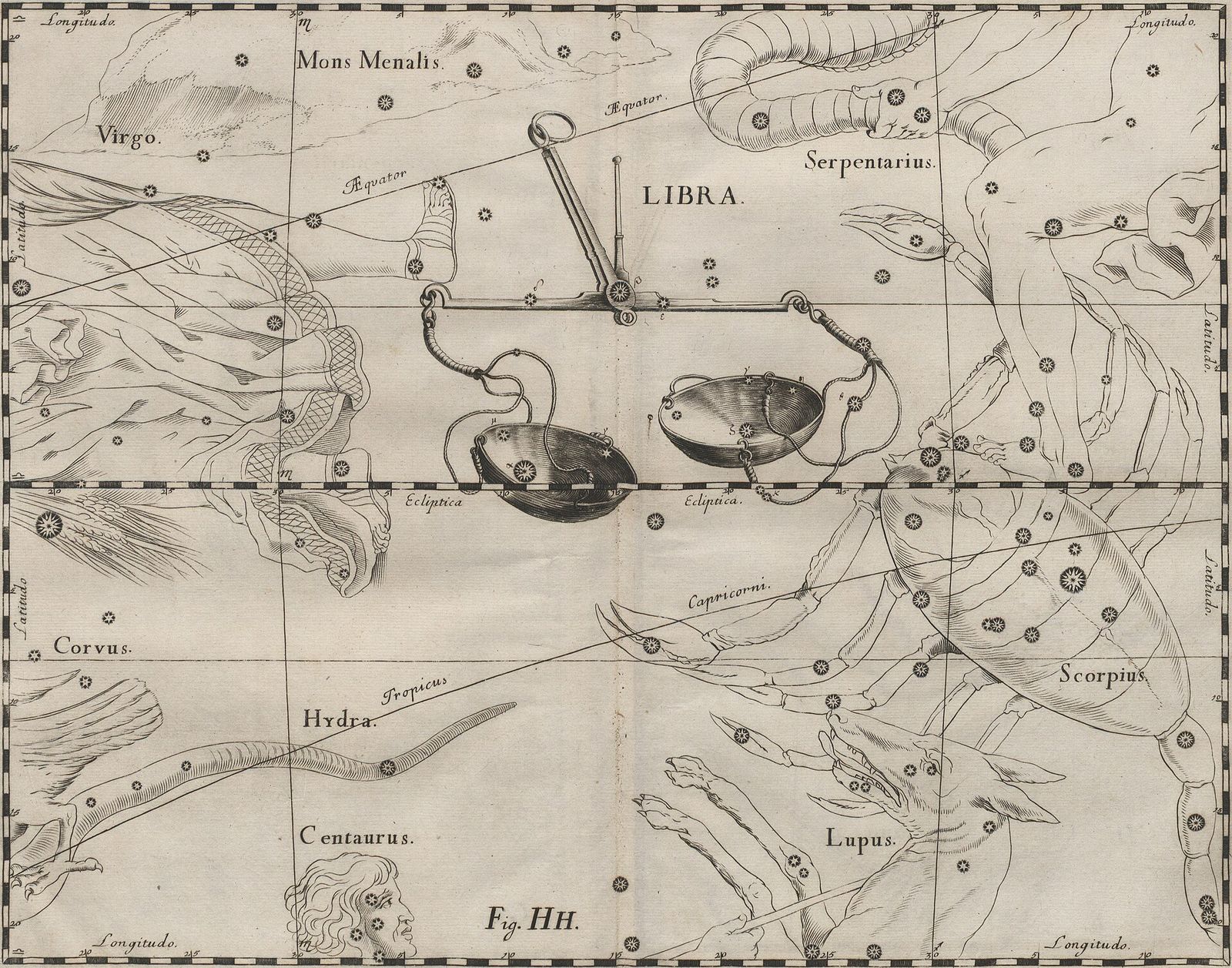
Engraving from 1690: Libra, with its beam and two pans, between Virgo and Scorpius, on a grid of longitudes.
Johannes Hevelius, Firmamentum Sobiescianum, 1690, Libra. Hevelius drew the sky as seen from outside a celestial globe, so his figures are mirror images of what we see from Earth.

Signs and constellations, two zodiacs

The astrologers’ zodiac divides the Sun’s apparent path into twelve equal parts of 30 degrees, counted from the vernal point, where the Sun stands at the March equinox. Constellations, by contrast, are groups of stars of very unequal size.

A little over two thousand years ago, the two systems roughly matched. Since then the Earth’s axis has slowly wobbled, like a spinning top that is running down. This motion, the precession of the equinoxes, shifts the vernal point by about one degree every 72 years. The Greek astronomer Hipparchus was the first to describe it, in the 2nd century BC.

1930

The International Astronomical Union publishes the boundaries of the 88 constellations, drawn by the Belgian astronomer Eugène Delporte at the observatory in Uccle.

With these official boundaries, the Sun passes through thirteen constellations over the year, including Ophiuchus, the Serpent Bearer, from late November to mid-December. The signs have stayed at twelve. This site keeps both: the sign for tradition and pleasure, the constellation for what you can actually see.