The ram with the golden fleece
For the Greeks, this is the ram that rescued Phrixus and Helle. Sent on Hermes’s orders, the golden-fleeced animal carried the two children through the air. Helle slipped off and drowned in the Dardanelles; Phrixus reached Colchis.
Ptolemy reports in the Almagest that Hipparchus saw the creature’s muzzle in the star Hamal.
From labourer to ram
The MUL.APIN tablets, dated to the 12th or 11th century BC, saw no ram here but ‘the agrarian worker’, the hired man. Later Babylonian tradition turned it into a ram, probably through Dumuzi the shepherd.
In 130 BC Hipparchus placed the vernal point, the start of the zodiac of signs, south of Gamma Arietis. Precession has since carried it into Pisces, and it will reach Aquarius around the year 2600.
The real constellation
Its brightest stars, Hamal, Sheratan and Mesarthim, range from second to fourth magnitude. Several meteor showers belong to it too, including the Daytime Arietids, which peak on 7 June in broad daylight.
From Brussels, Hamal climbs to 63 degrees and is highest around 10 pm in early December. In 2026 the Sun stood in front of the constellation from 19 April to 14 May, while the sign ran from 20 March to 20 April.
Its stars
Hamal
Magnitude 2.00, about 66 light years away. An orange giant whose name comes from the Arabic for ‘the lamb’ or ‘the head of the ram’.
Sheratan
Magnitude 2.64, about 59 light years away. Hermann Carl Vogel recognised it as a double star in 1903.
Mesarthim
Combined magnitude 3.9, about 164 light years away. Robert Hooke found it to be double in 1664.
A blue-white star
Magnitude 3.63, about 165 light years away, spectral type B8.
In art and history
Aries changed shape along the way: a man at work became an animal.
- BabylonIn the MUL.APIN tablets the constellation is LÚ.ḪUN.GÁ, ‘the agrarian worker’.
- Ptolemaic EgyptOn the Dendera zodiac, now in the Louvre, the ram appears in its familiar Graeco-Roman form.
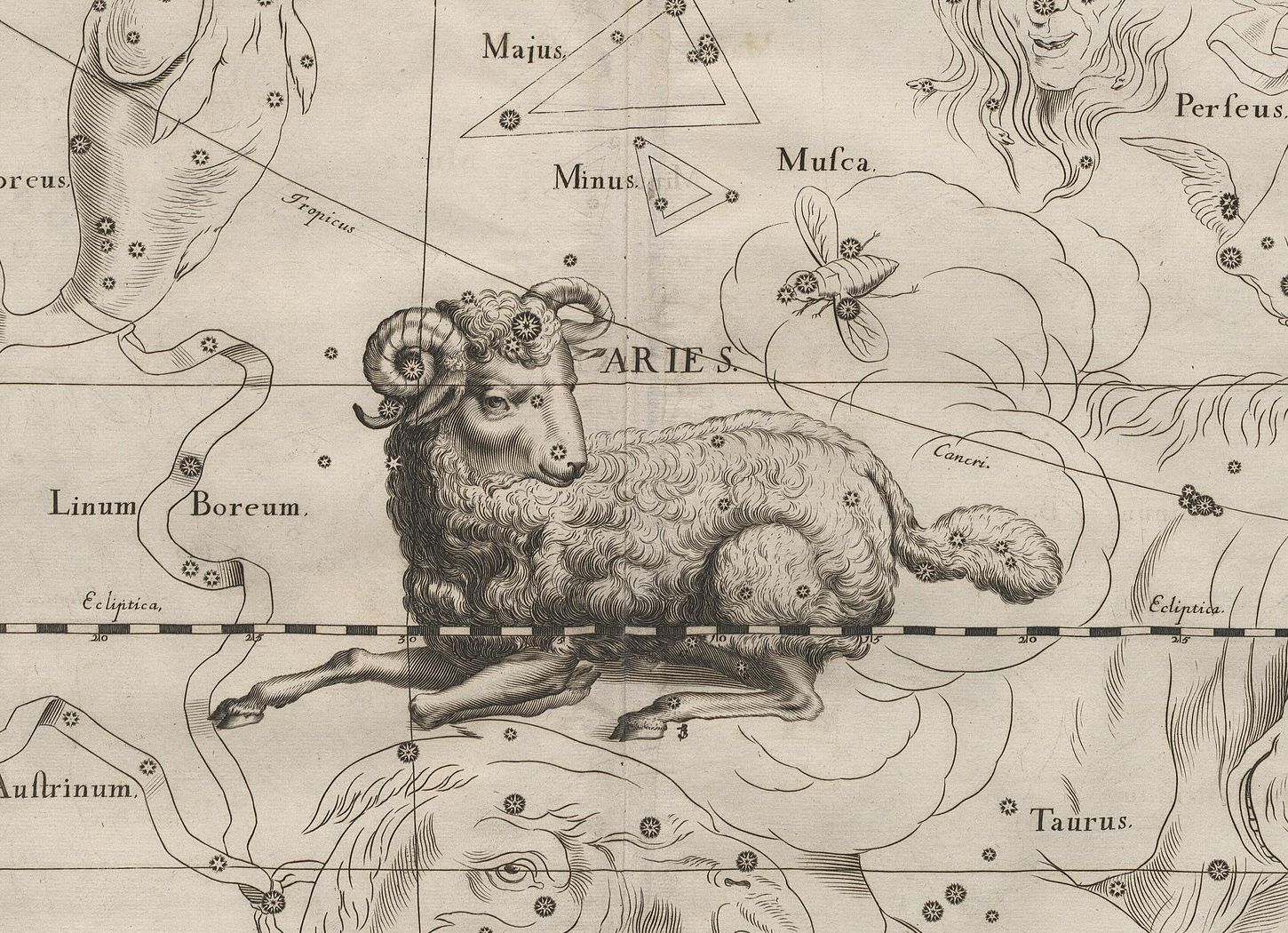
- Scientific atlasesIn 1690 Hevelius engraved a reclining ram looking back over its shoulder, on a chart where every star is measured.
