Europa’s bull
Zeus took the form of a white bull to carry off Europa, a Phoenician princess. It is the best-known story, but not the only one.
Others see Io in these stars, turned into a heifer by Zeus to hide her from Hera. The mythographer Acusilaus recognised the Cretan Bull, one of the labours of Heracles.
The Bull of Heaven
The MUL.APIN tablets call the constellation GU4.AN.NA, ‘the Bull of Heaven’. The researcher Michael Rappenglück even believes Taurus and the Pleiades appear on a wall of the Hall of the Bulls at Lascaux, painted around 15,000 BC. That is a hypothesis, not an established fact.
The real constellation
Taurus holds two famous star clusters. The Pleiades, the ‘Seven Sisters’, number some 500 to 1,000 stars around 100 million years old. The Hyades spread over about 5 degrees and can be seen whole with the naked eye or binoculars.
From Brussels, Aldebaran climbs to 56 degrees and is highest around 10 pm in early January. In 2026 the Sun stood in front of Taurus from 14 May to 21 June: at the June solstice it is now in Taurus, no longer in Cancer.
Its stars
Aldebaran
Magnitude 0.85, about 65 light years away. An orange giant whose Arabic name means ‘the follower’.
Elnath
Magnitude 1.65, about 131 light years away. It marks one of the bull’s horns, on the border with Auriga; its Arabic name refers to butting.
The Pleiades
Their seven most prominent stars reach at least magnitude 6, hence the name ‘Seven Sisters’.
The Crab Nebula
The remnant of a supernova seen on 4 July 1054, which reached magnitude −4. The nebula now shines at around magnitude 8.4.
In art and history
Few figures in the sky have had as long a career as the bull.
- BabylonThe MUL.APIN tablets call it GU4.AN.NA, ‘the Bull of Heaven’.
- Ptolemaic EgyptThe bull appears on the Dendera zodiac, now in the Louvre, in its Graeco-Roman form.
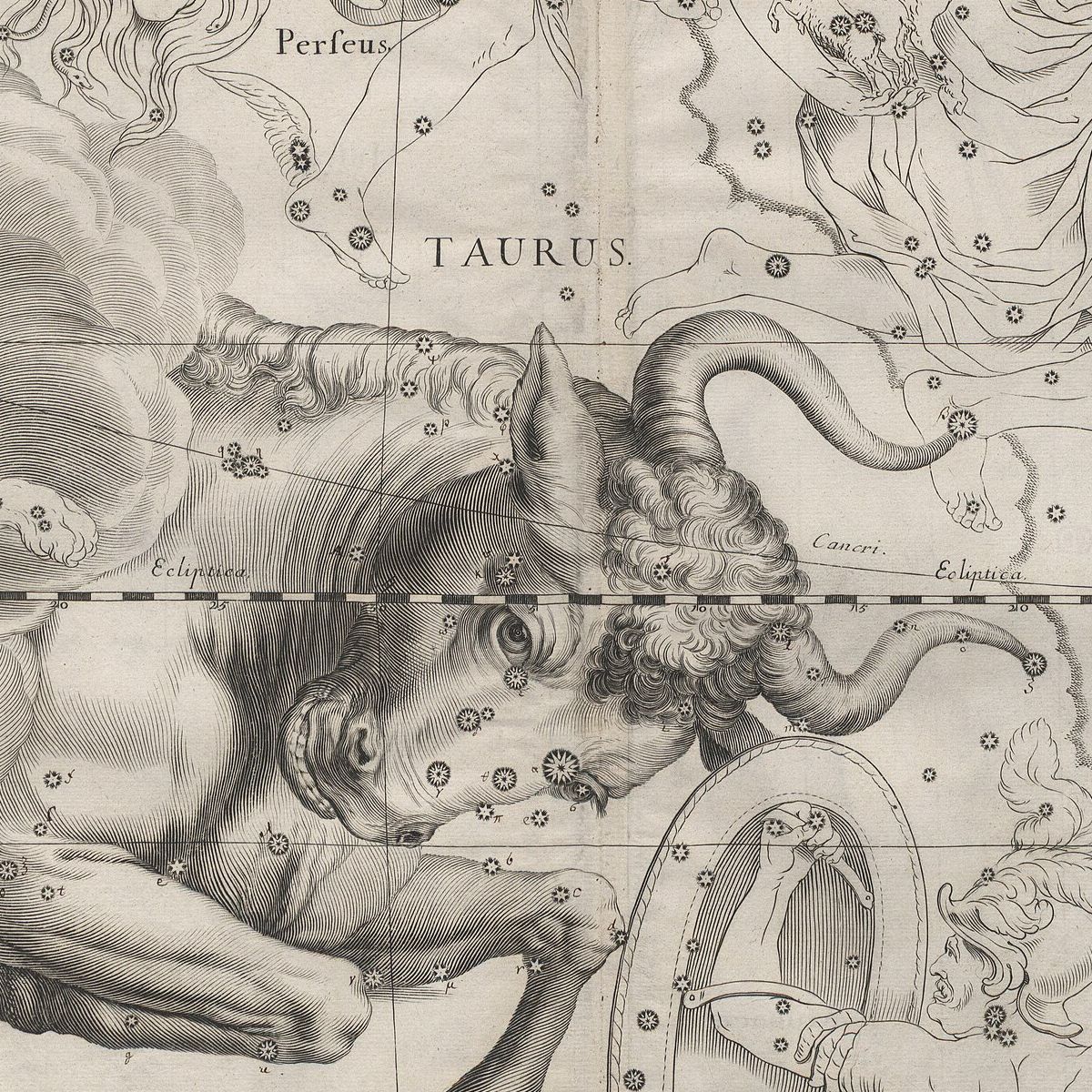
- Scientific atlasesIn 1690 Hevelius engraved the front half of a bull, horns first, bursting out of the clouds.
