Hera’s crab
While Heracles was fighting the Lernaean Hydra, a crab appeared and bit his foot. The hero killed it, and Hera placed the creature among the stars.
The story is preserved by pseudo-Hyginus in De astronomia. Aratus already called the constellation Karkinos, the crab.
The Tropic of Cancer
In antiquity the Sun stood in front of Cancer at the June solstice, when it is directly overhead at 23.437 degrees north. The parallel is still called the Tropic of Cancer, even though precession has moved the solstice Sun into Taurus.
In Babylon, MUL.AL.LUL could mean a crab or a snapping turtle: boundary stones show turtles, and no crab at all.
The real constellation
At the heart of the constellation lies the Beehive Cluster (M44), about 590 light years away. Ptolemy described it as ‘the nebulous mass in the breast of Cancer’; Galileo counted forty stars in it in 1609. Some 1,010 probable members are known today.
From Brussels, Tarf climbs to 48 degrees and is highest around 10 pm in early March. In 2026 the Sun crossed Cancer from 21 July to 11 August. This week Mars is there, rising around .
Its stars
Tarf
Magnitude 3.5, about 290 light years away: the brightest star of a very modest constellation. A double star.
Asellus Australis
Magnitude 3.9, about 131 light years away. With Asellus Borealis it forms ‘the donkeys’ eating from the manger, the mounts of Dionysus and Silenus in the war against the Titans.
Asellus Borealis
Magnitude 4.67, about 181 light years away.
Acubens
Magnitude 4.26, about 181 light years away. A multiple star system.
In art and history
Crab, turtle, lobster: Cancer’s creature has often changed its shell.
- BabylonThe constellation is MUL.AL.LUL, and boundary stones show it as a turtle.
- AntiquityPtolemy recorded the constellation in the Almagest in the 2nd century, after Aratus and Hipparchus.
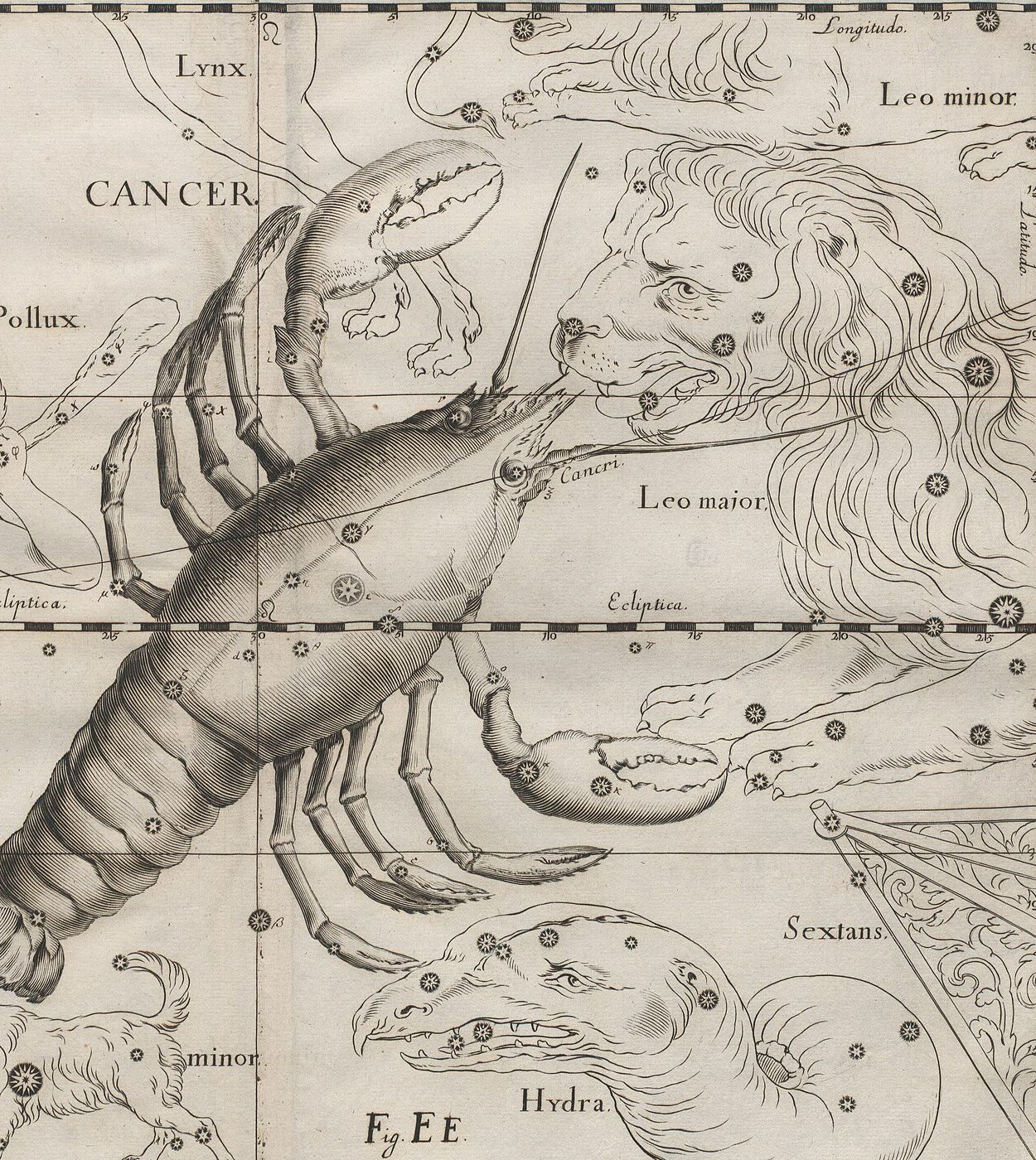
- Scientific atlasesIn 1690 Hevelius engraved it as a large long-clawed crustacean, more lobster than crab.
