Castor and Pollux
Castor and Pollux are the sons of Leda: Pollux of Zeus, Castor of Tyndareus, king of Sparta. When Castor died, Pollux asked Zeus to grant him immortality, and the god united the two brothers in the sky.
Sailors saw them as their protectors, and their presence was linked with St Elmo’s fire.
Two planets found here
William Herschel discovered Uranus on 13 March 1781, close to the star Eta Geminorum. In 1930 Clyde Tombaugh found Pluto on photographic plates centred on Delta Geminorum.
When Johann Bayer handed out his Greek letters in 1603, he gave ‘alpha’ to Castor although Pollux is brighter: he did not clearly distinguish which of the two outshone the other.
The real constellation
The Geminids, one of the richest meteor showers of the year, peak on 13 and 14 December, with up to about a hundred meteors an hour.
From Brussels, Pollux climbs to 67 degrees and is highest around 10 pm in late February. In 2026 the Sun crossed Gemini from 21 June to 21 July.
Its stars
Pollux
Magnitude 1.14, about 34 light years away. An orange giant with a planet.
Castor
Magnitude 1.6 to the naked eye, about 52 light years away. That single point is really a system of six stars.
Alhena
Magnitude 1.9, about 105 light years away, blue-white.
An open cluster
Magnitude 5, about 2,800 light years away, discovered in 1745 by Philippe Loys de Chéseaux. It holds some 200 stars.
In art and history
The twins have often changed names, never their number.
- BabylonCastor and Pollux already formed ‘the Great Twins’ there, two minor gods named Meshlamtaea and Lugalirra.
- AntiquityPtolemy lists Gemini among the 48 constellations of his catalogue, in the 2nd century.
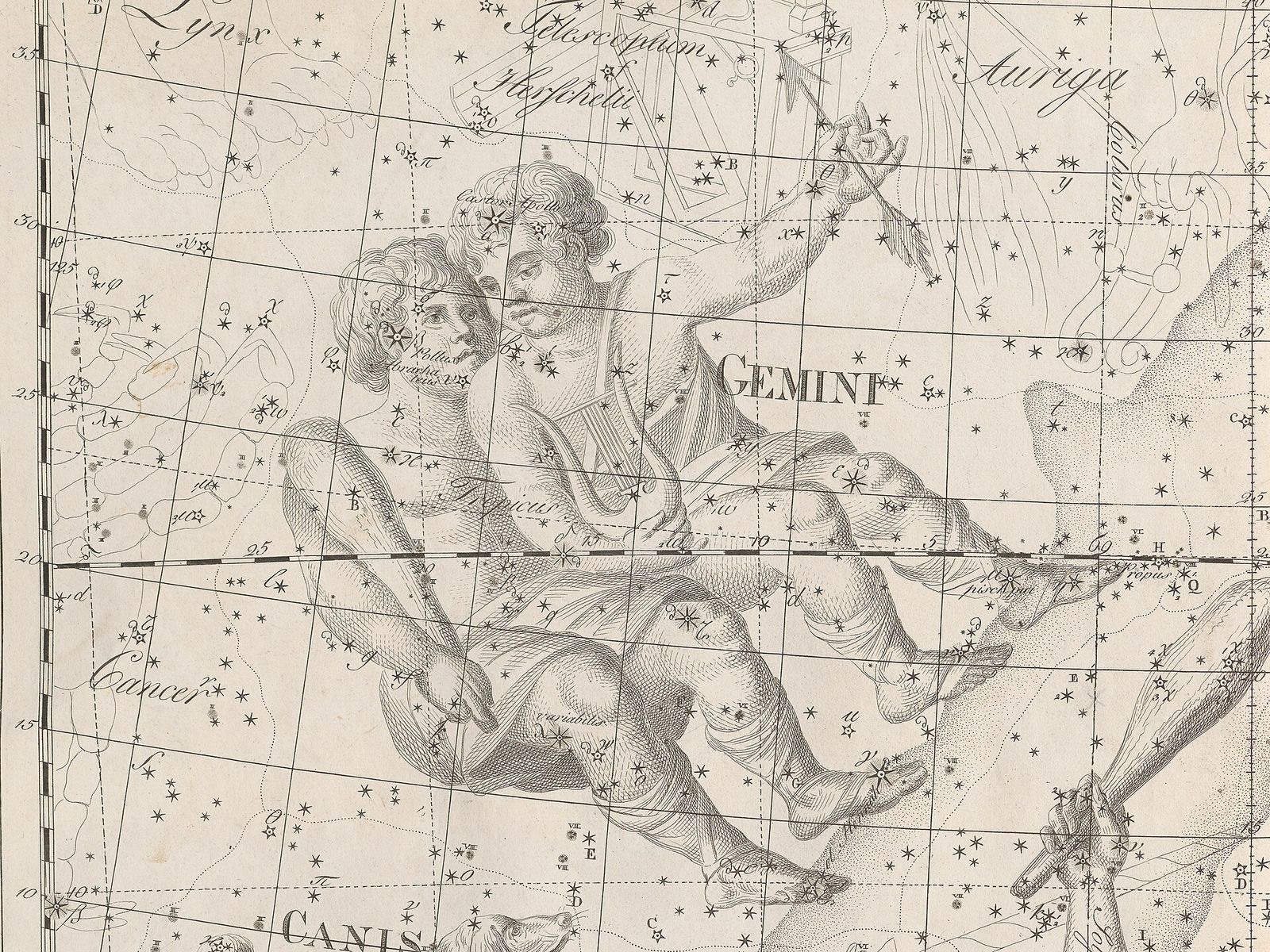
- Scientific atlasesIn 1801 Bode engraved them embracing and draped, on a chart crowded with thousands of stars.
