The Nemean lion
Leo is the Nemean lion, killed by Heracles in the first of his twelve labours; Zeus set it in the sky to commemorate the feat.
Ovid calls it Herculeus Leo, Hercules’s lion, and Manilius ‘the star of Jupiter and Juno’.
The king’s star
In Babylon the constellation was UR.GU.LA, ‘the great lion’, and Regulus ‘the star that stands at the lion’s breast’, also called Sharru, ‘the king’. It was one of the four ‘royal stars’ of the Persian monarchy. Its Latin name means ‘little king’.
The real constellation
Six stars draw the Sickle, a backwards question mark ending in Regulus. Among bright stars Regulus lies closest to the ecliptic, 0.465 degrees away: the Moon passes in front of it in spates about every 9.3 years, the latest in 2026.
From Brussels, Regulus climbs to 51 degrees and is highest around 10 pm in mid-April. In 2026 the Sun crossed Leo from 11 August to 17 September. This week Jupiter is there, rising around .
Its stars
Regulus
Magnitude 1.35, about 79 light years away. It spins once every 15.9 hours; its equator moves at about 320 km/s, which visibly flattens it.
Denebola
Magnitude 2.14, about 36 light years away. It marks the lion’s tail.
Algieba
A gold-yellow double giant about 130 light years away; its two stars orbit each other in about 600 years.
Zosma
Magnitude 2.56, about 58 light years away, blue-white.
In art and history
A lion in Babylon, a lion in Greece, a lion in the atlases: the figure has stayed true to itself.
- BabylonUR.GU.LA, ‘the great lion’, with Regulus at its breast.
- The LeonidsEvery year around 14 and 15 November these shooting stars seem to burst out of Leo. They come from Comet Tempel-Tuttle, which causes strong outbursts about every 35 years.
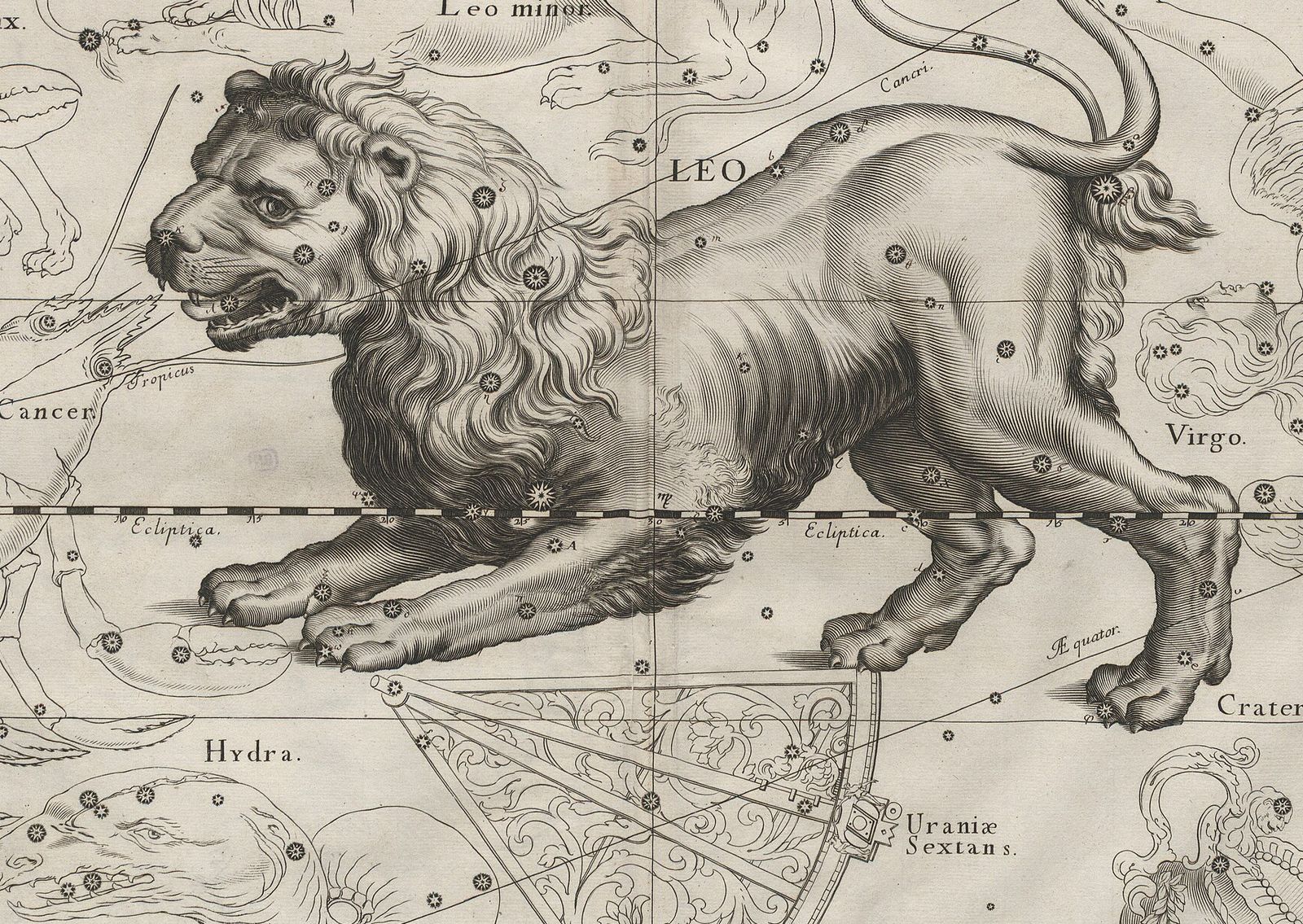
- Scientific atlasesIn 1690 Hevelius engraved a striding lion with open jaws, above the Sextant he had added to the sky himself.
