The hunter and the beast
The oldest version survives only in fragments. An astronomical poem attributed to Hesiod, known through the Catasterismi of Pseudo-Eratosthenes, tells how Orion hunted on Crete with Artemis and her mother Leto. He boasted that he would kill every beast on earth. The Earth then sent up against him a scorpion of very great size, and its sting killed him.
At the prayer of Artemis and Leto, Zeus set the hunter among the stars for his courage, and the Scorpion as well, as a memorial of what had happened. The monster reaches the sky, in other words, as evidence.
Later writers change the scenery, seldom the ending. In Aratus, in the third century BC, the story takes place on Chios and Orion has vexed Artemis. Ovid, in the Fasti, has the Earth unleash the beast and Latona welcome Orion among the stars. Hyginus even knows a version with no scorpion at all: Apollo challenges his sister to hit a distant speck on the sea, and Artemis unknowingly shoots Orion as he swims.
The rule of the two horizons
Aratus draws an astronomer’s lesson from the tale, and his line is worth quoting whole. Hyginus says the same in prose: the constellation was placed so that when the Scorpion rises, Orion sets.
“At the rising of the Scorpion in the East Orion flees at the Western verge.” Aratus, Phaenomena, translated by Mair.
We checked the rule for Brussels. Betelgeuse, Orion’s shoulder, sets every day some twenty minutes before Antares, the heart of the Scorpion, rises; Antares in turn vanishes a little over three hours before Betelgeuse returns. Across twenty-four hours there is not a single minute when both stars stand above the horizon together. Rigel never meets Antares either.
The rule does depend on latitude. Computed for Athens, it lets Betelgeuse and Antares share the sky for seventeen minutes a day, just above the horizon; at the equator, for nearly an hour and a half. In Belgium, Antares never climbs higher than 13 degrees. The Scorpion already keeps a low profile here, and the hunter avoids it with ease.
Long before the Greeks
Orion has had other careers. Babylonian catalogues of the late Bronze Age call the constellation MUL.SIPA.ZI.AN.NA, ‘the true shepherd of Anu’, the god of the sky. In Egypt its stars formed the god Sah, linked with Sopdet, that is Sirius, which rises after him, and later identified with Osiris.
In Homer, Orion is already in the sky: he appears on the shield of Achilles in the Iliad, where Sirius is his dog. In the Odyssey, Odysseus glimpses him in the underworld, still hunting, a bronze club in his hand. Hesiod, in the Works and Days, sets the farming calendar by his rising and setting.
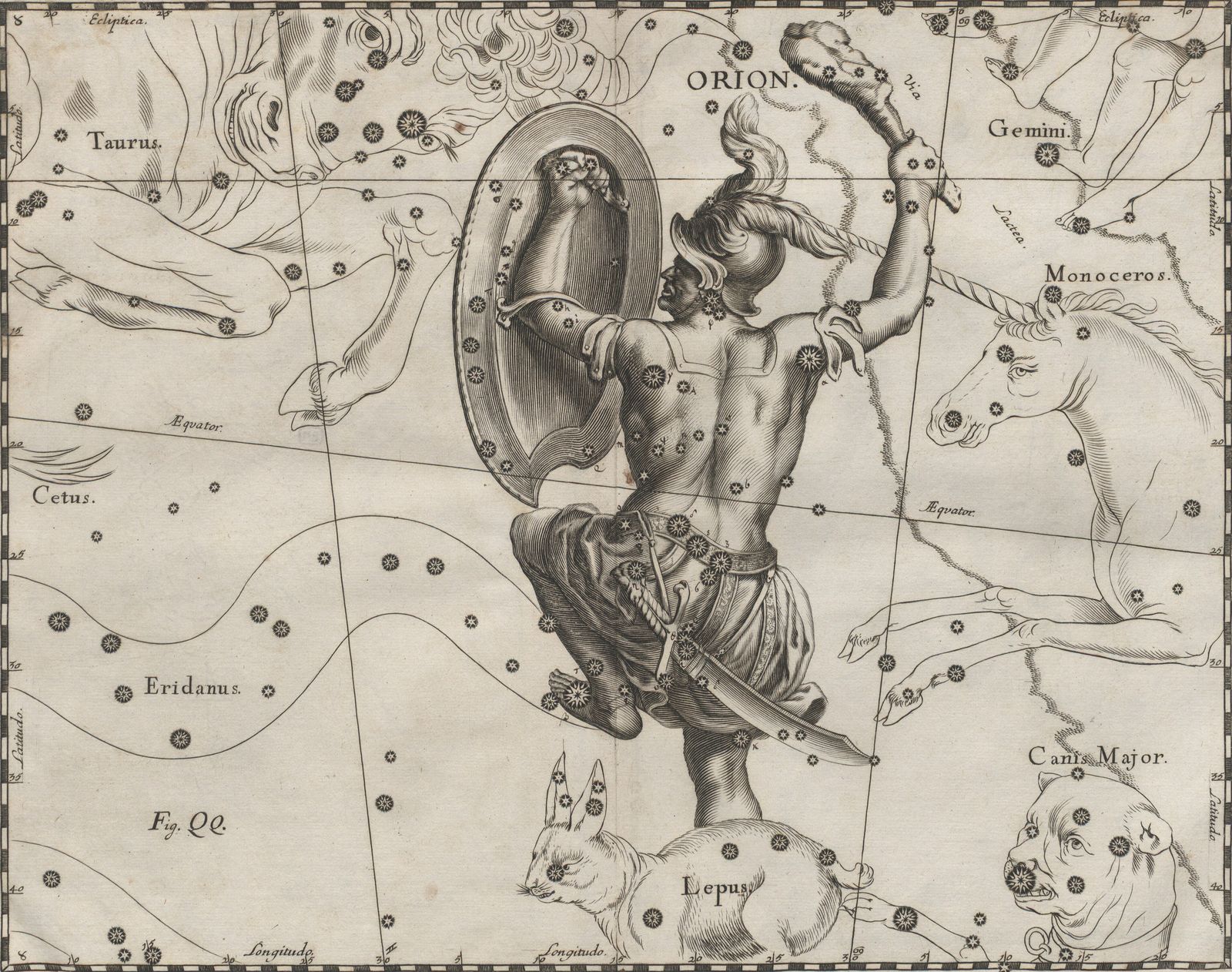
Ptolemy counted it among his 48 constellations in the second century. It is one of today’s 88 official constellations, covering 594 square degrees, 26th in size. Lying across the celestial equator, it can be seen from almost the whole Earth, between latitudes 80 degrees north and 68 degrees south.
Its stars
Betelgeuse
A red supergiant some 400 to 600 light years away, depending on the estimate, with a radius 640 to 764 times the Sun’s. The name comes from the Arabic yad al-jawzā’, ‘the hand of al-Jawzā’’, garbled in the thirteenth century by a misread letter. Between October 2019 and February 2020 it faded from magnitude 0.5 to 1.7, veiled by a cloud of dust.
Rigel
A blue supergiant about 850 light years away, usually the seventh brightest star in the sky and almost always brighter than Betelgeuse. Its Arabic name means ‘the left foot of al-Jawzā’’.
Bellatrix
Magnitude 1.6, about 250 light years away. The Latin name means ‘female warrior’; it first belonged to Capella, and Viennese astronomers moved it to this star in the fifteenth century.
The Belt
Mintaka, Alnilam and Alnitak, three stars in a row that need no chart. Mintaka is double: its two stars orbit each other every 5.73 days.
The Orion Nebula
A pale smudge in the middle of the sword, below the Belt, visible to the naked eye about 1,300 light years away. Peiresc recognised its nebulous nature on 26 November 1610. It is the closest region of massive star formation to us.
Where to find it this week
On the evening of , Bellatrix rises at , Betelgeuse at and Rigel at , in the east. Each evening these risings come about four minutes earlier.
The best time is the end of the night. On at , Betelgeuse stands almost due south, 46 degrees up, with Rigel at 29 degrees. The Moon has been down since and astronomical twilight only begins at : the sky is dark, provided you can escape the street lights.
It is also the week of the Orionids, the shooting stars born of dust from Halley’s Comet, whose radiant lies in Orion, near Betelgeuse. Their maximum usually falls around 21 or 22 October, with at best some twenty meteors an hour under a perfect sky.
The Sun enters the sign of Scorpio on at . Orion is unconcerned: by the time the constellation Scorpius returns to our summer evenings, the hunter will have left the stage.
Frequently asked questions
- Why are Orion and the Scorpion never visible at the same time?
- More than ten hours of right ascension separate them. At Belgium’s latitude, Betelgeuse sets before Antares rises, and Antares sets more than three hours before Betelgeuse rises. Further south the rule loosens: in Athens the two stars share the sky for seventeen minutes a day.
- When can Orion be seen from Belgium?
- In October you need to stay up late or rise early: it rises around 23:00 and stands in the south before dawn. It then appears earlier and earlier, and is easiest to see in the evening from January to April.
- Will Betelgeuse explode?
- It will end as a supernova, most likely within the next 100,000 years according to current estimates. It would then shine as brightly as a half Moon for over three months, with no danger to Earth.
