A sky without a land registry
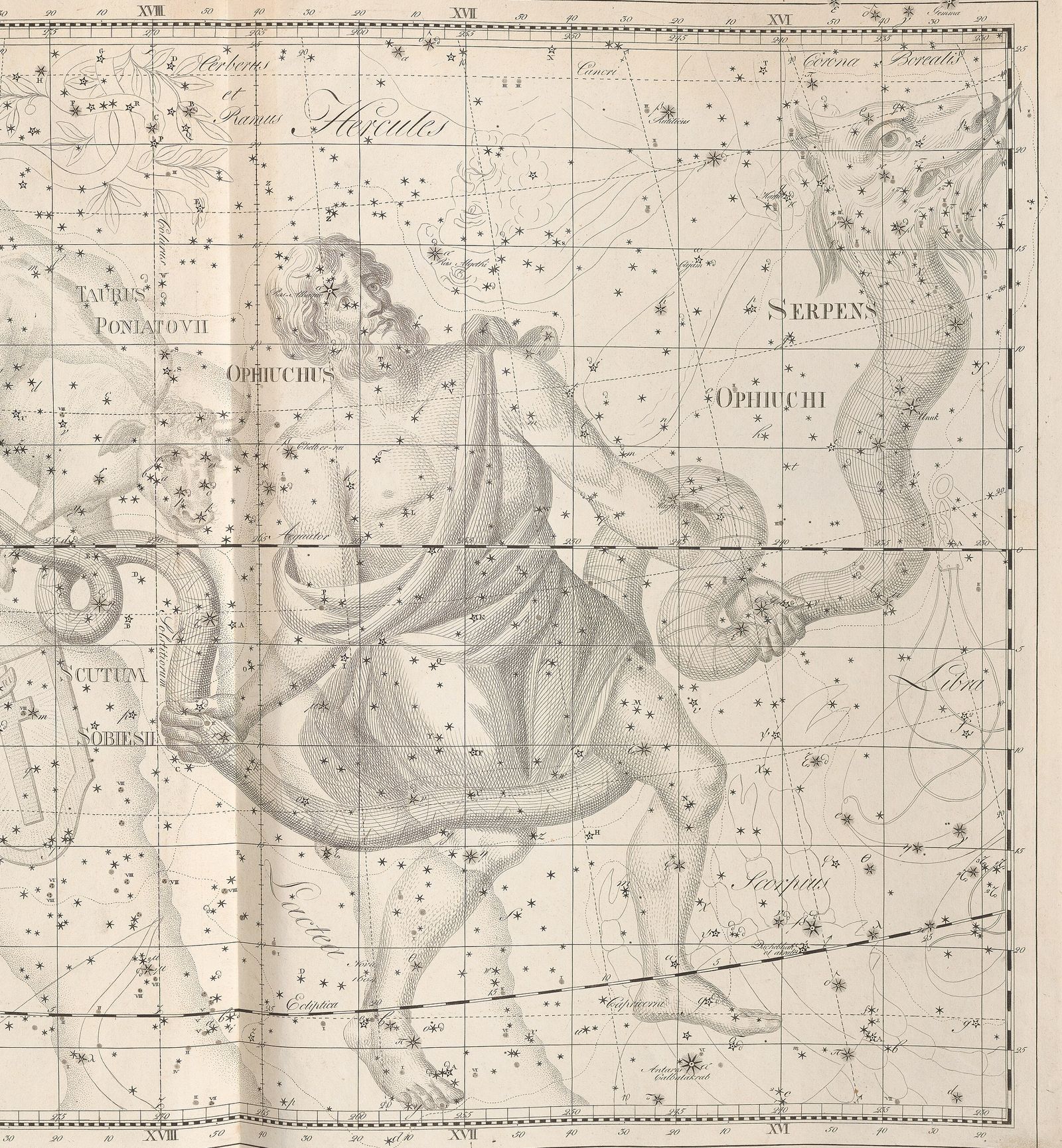
At the start of the twentieth century, every star atlas carved up the sky its own way. Depending on the chart, you could count barely 70 constellations or nearly a hundred. A star might change figure from one book to the next, and inventions such as Poniatowski’s Bull, plainly visible on Bode’s plate, were still doing the rounds. It did not survive the official list.
In 1801 Bode surrounds his figures with dotted lines, but they follow the drawing, not a rule. The method that would win came from Argentina. In the atlas of his Uranometria Argentina, published in 1877, the American astronomer Benjamin Gould bounded the southern constellations with lines of right ascension and declination, the meridians and parallels of the sky.
The astronomer from Genappe
Eugène Delporte was born in 1882 in Genappe, south of Brussels. He took his doctorate at the Free University of Brussels in 1903 and joined the Royal Observatory of Belgium at Uccle the same year. He was its director from 1936 to 1947, and he died at Uccle on 19 October 1955.
In 1922 the young International Astronomical Union adopted a list of 88 constellations and set up a commission, chaired by Delporte, to give them borders. The report came in 1928, the year the Union officially adopted the boundaries at its General Assembly in Leiden. The book followed in 1930: Délimitation scientifique des constellations, from Cambridge University Press, with its tables and charts.
That same year King Albert I made him an Officer of the Order of Leopold. A civil servant of the heavens, decorated for surveying.
Meridians and parallels
Delporte took Gould’s method and applied it to the whole sky. Every border follows an arc of right ascension or declination, computed for the epoch 1875, the year of Gould’s proposal. The result looks like a stepped land registry, all stairs and right angles. The old figures keep their stars, even at the cost of some odd outlines.
The oddest case is Serpens. Ophiuchus grips the serpent with both hands and so stands in the middle: Serpens is the only one of the 88 constellations split into two separate pieces, the Head to the west and the Tail to the east. Bode’s plate shows exactly why.
Sizes vary wildly. Hydra covers 1,303 square degrees, Crux 68, out of a sky of 41,253. And the grid is no longer quite square. The precession of the equinoxes shifts coordinates by about 50 arcseconds a year, a little over two degrees since 1875: on a modern chart, Delporte’s borders lean slightly. The stars themselves have not changed constellation.
Six days in Scorpius
Those lines also decide when the Sun passes in front of the zodiac constellations. Worked out with the official boundaries, the dates have nothing of the twelve equal 30-degree slices that make up the signs. In 2026 the Sun stood in front of Virgo from to , more than 44 days. It then crosses Libra until , and Scorpius in six and a half days.
On at it moves into Ophiuchus, leaving only on for Sagittarius. Ophiuchus touches the ecliptic because the border falls there, not because someone forgot a thirteenth sign. The signs remain a convention of tradition; the constellations are a matter of celestial geography.
The Moon crosses these invisible lines too. During the night of 22 to 23 October, at , it passes from Aquarius into Pisces. During the night of 25 to 26 October, at , it enters Aries, high in the south-west, a little over three hours before the full Moon at .
What bears his mark
Amor
Photographed at Uccle on 12 March 1932. This asteroid, about a kilometre across, gave its name to a whole family: the Amor asteroids, which approach Earth’s orbit from outside without crossing it.
Adonis
Discovered on 12 February 1936. It belongs to the Apollo group, asteroids whose orbits cross Earth’s.
Comet du Toit-Neujmin-Delporte
Found on 18 July 1941 in South Africa by Daniel du Toit, on a plate of 25 July in Crimea by Grigory Neujmin, and on 19 August at Uccle by Delporte. It returns roughly every 6.4 years.
Delportia
Discovered by Delporte himself on 28 November 1932 and later named in his honour. He found 66 asteroids in all; one of them, (1276) Ucclia, bears the name of the observatory’s municipality.
The crater Delporte
A lunar crater also bears his name. The surveyor of the sky has his own plot on the Moon.
Frequently asked questions
- How many official constellations are there?
- 88. The International Astronomical Union fixed the list in 1922 and adopted the boundaries in 1928; Eugène Delporte published them in 1930. Since then every point in the sky belongs to exactly one constellation.
- Why are constellation boundaries stepped?
- They follow lines of right ascension and declination, the meridians and parallels of the sky, computed for the year 1875. Precession has since tilted them slightly on modern charts.
- How long does the Sun spend in front of Scorpius?
- In 2026, from 23 to 30 November, about six and a half days, according to the official boundaries. The sign of Scorpio runs from 23 October to 22 November: signs are equal 30-degree slices, regardless of the size of the constellations.
