
A rumour that keeps coming back
The first version had fourteen signs, not thirteen. In 1970 Steven Schmidt proposed in Astrology 14, published by Bobbs-Merrill, a zodiac of fourteen equal parts, with Ophiuchus and Cetus joining the twelve old ones. Time magazine asked the astrologer Carroll Righter at the time, and he dismissed the theories as ‘meaningless’.
Twenty-five years later the British astrologer Walter Berg kept Ophiuchus and dropped Cetus. The 13 Signs of the Zodiac came out from Thorsons in London in 1995, but it was Japan that took to it: a translation appeared there as early as December 1995, from Shodensha.
In January 2011 the story went round the press. Parke Kunkle, who taught astronomy at Minneapolis Community and Technical College and was a member of the Minnesota Planetarium Society, told the Minneapolis Star Tribune that the Sun is not in front of the expected constellations on the dates the horoscopes give, and that it also passes through Ophiuchus. According to the papers that picked the story up, he asked for nothing more. ‘I just mentioned that it’s there, and astronomers actually count it’, he told Gizmodo. The Christian Science Monitor put it plainly: ‘Kunkle didn’t change anything at all.’ The headlines announced new signs all the same.
In September 2016 NASA got drawn in. One of its texts pointed out that the Earth’s axis has shifted since the signs were defined, and that the Sun also passes in front of a thirteenth constellation. That was enough for the agency to be credited with rewriting the zodiac. On its Tumblr it set the record straight, as quoted by the Christian Science Monitor on 27 September: ‘So, we didn’t change any zodiac signs.’ And further on: ‘We just did the math.’ In July 2020 the rumour resurfaced, and NASA repeated on Twitter: ‘No, we did not change the zodiac.’
Thirteen constellations, twelve signs
The whole misunderstanding comes down to two words that get swapped. A constellation is a region of sky, tiny or vast: there are 88 of them, bounded since 1930 by the lines of Eugène Delporte, and Ophiuchus, at 948 square degrees, is the eleventh largest. A sign is a 30-degree slice of the Sun’s apparent path, counted from the vernal point, where the Sun stands at the March equinox. Twelve times 30 is 360: the sum comes out by design, like the hours on a clock face.
The Sun crosses thirteen constellations. The signs have stayed at twelve.
The Sun, for its part, does no arithmetic. Over the year it passes in front of thirteen constellations, because the feet of Ophiuchus reach down to the ecliptic, between Scorpius and Sagittarius. In 2026 it reaches Scorpius on , leaves it for Ophiuchus on and does not get to Sagittarius until . Six and a half days for Scorpius, more than eighteen for the passenger: the guest outstays the resident.
Making Ophiuchus a sign would therefore mean carving up the circle again. Schmidt did just that, in fourteen equal parts; mainstream astrology kept its twelve. While the Sun crosses Ophiuchus, that astrology places it in the sign of Sagittarius, which it entered on . Both statements are true at once, each within its own convention. As for the dates of an ‘Ophiuchus sign’, they vary from one author to the next, and this site gives none.
Asclepius, the healer struck by lightning
Which leaves the man with the snake. His Greek name, ophioûkhos, means ‘serpent-bearer’, in Latin Serpentarius. Aratus already describes him, drawing on Eudoxus of Cnidus, a fourth-century BC astronomer whose catalogue is lost, and Ptolemy counts him among his 48 constellations. Depending on the author, the Greeks saw Apollo wrestling the serpent of Delphi, or Laocoön, the Trojan priest killed by sea serpents. The identification that won, above all among the Romans, is Asclepius, the divine healer.
Hyginus, following Eratosthenes here, names the last dead man Asclepius is said to have brought back to life: Hippolytus, ‘killed by the injustice of his stepmother and the ignorance of his father’. Others, he adds, name Glaucus, son of Minos. Jupiter, ‘as for a sin’, strikes Asclepius’s house with a thunderbolt and burns it. Then he sets him among the stars, a snake in his hand, ‘for the sake of Apollo’, his father.
The same chapter explains the snake. Ordered to revive Glaucus and shut in a secret prison, Asclepius kills a snake that has crept up his staff; a second one arrives with a herb in its mouth and revives the first. Asclepius only has to follow suit. The Theoi site, which publishes the text, notes that elsewhere it is usually the seer Polyidus who brings Glaucus back.
Apollodorus, in his Library, gives a different reason for the divine anger. Asclepius had received the Gorgon’s blood from Athena, and with it ‘he not only prevented some from dying, but even raised up the dead’. Zeus, ‘fearing that men might acquire the healing art from him’, strikes him with a thunderbolt, and Apollo takes revenge on the Cyclopes who had forged it. For the list of the revived, Apollodorus lines up his sources like a court clerk: Capaneus and Lycurgus according to Stesichorus, Hippolytus according to the author of the Naupactica, Tyndareus according to Panyasis, Hymenaeus according to the Orphics, Glaucus according to Melesagoras. To every poet his own miracle.
The new star of 1604
The real sky of Ophiuchus had its own apparition. On 9 October 1604, in northern Italy, Lodovico delle Colombe spotted, near the star Theta Ophiuchi at the figure’s foot, a light that had not been there before. Kepler, then at the imperial court in Prague, followed it from mid-October. It climbed to about magnitude −2.5, brighter than any star in the night sky, stayed visible in daylight for more than three weeks, and to the naked eye for eighteen months.
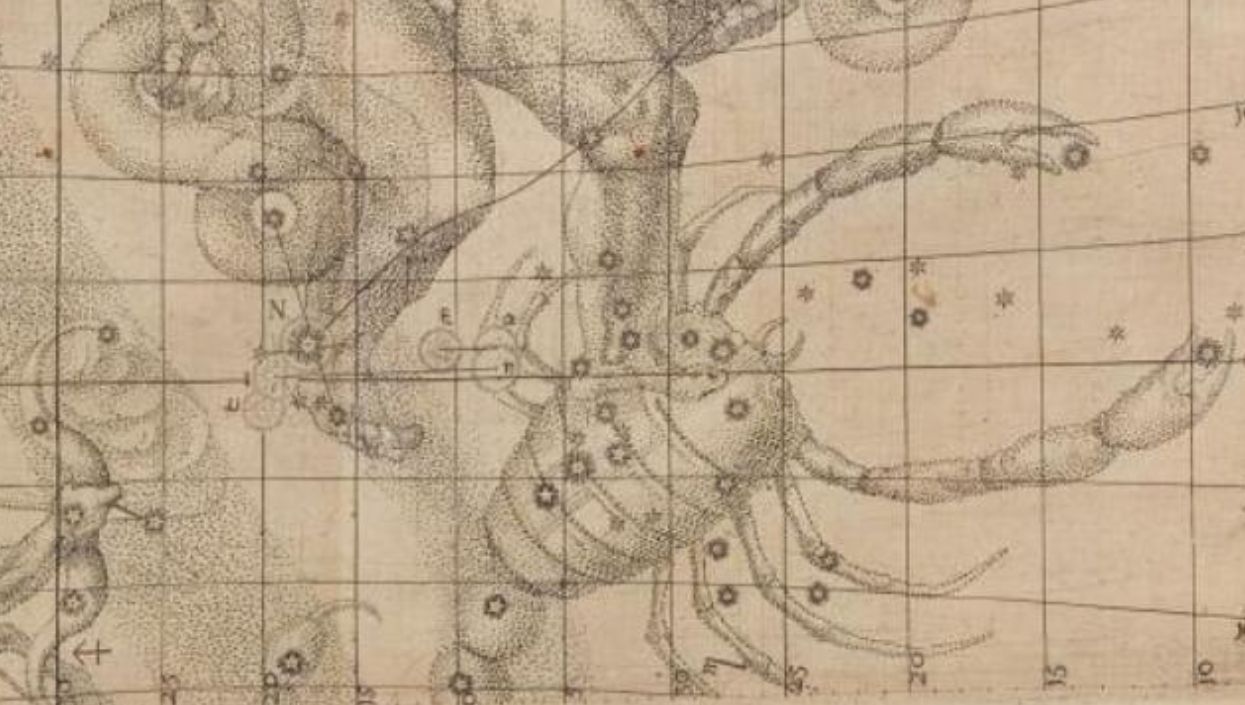
Kepler had been watching a triple conjunction of Mars, Jupiter and Saturn, and the new star appeared at the same time, in the same part of the sky. He wrote a book about it, De stella nova in pede Serpentarii, ‘On the new star in the foot of the Serpent-bearer’, printed in Prague in 1606. His chart, at the top of this page, takes its figure and positions from Bayer, who had drawn Ophiuchus from behind in 1603. Kepler turned him round to face us: the star, marked with an N, is back on the right foot where traditional maps had put it.
Three objects in Ophiuchus
Rasalhague
The brightest star in the constellation, magnitude 2.1, about 49 light years away. The name comes from the Arabic raʼs al-ḥawwāʼ, ‘the head of the serpent collector’: it marks the figure’s head. Approved by the International Astronomical Union on 20 July 2016.
Barnard’s Star
A red dwarf six light years away, the nearest single star to the Sun: only the three stars of Alpha Centauri are closer. Magnitude 9.5, invisible to the naked eye. Edward Emerson Barnard measured its record motion of 10.3 arcseconds a year in 1916. In March 2025 four little planets were confirmed, each between about a fifth and a third as massive as Earth, around a star NASA calls ‘notorious among astronomers for a history of false planet detections’.
What is left of Kepler’s star
The light of 1604 was a Type Ia supernova. Its debris can be seen today in X-rays by the Chandra telescope, which calls it ‘the last such object seen to explode in our Milky Way galaxy’, with the possible exception of Cassiopeia A, for which only ambiguous sightings around 1680 exist.
Frequently asked questions
- Is Ophiuchus the 13th sign of the zodiac?
- No. It is the thirteenth constellation the Sun passes in front of. The signs remain twelve equal slices of 30 degrees. Neither NASA nor the International Astronomical Union has added one: the IAU sets constellations and star names, not signs.
- Did NASA change my zodiac sign?
- No. In 2016 it made clear that it had not changed any sign and had simply done the maths. In 2020 it repeated that it had not changed the zodiac.
- Where does the 13th sign rumour come from?
- From a fourteen-sign zodiac proposed by Steven Schmidt in 1970, then from Walter Berg’s thirteen-sign book (1995), translated in Japan the same year. In January 2011 remarks by the astronomer Parke Kunkle in the Minneapolis Star Tribune brought it back into the press.
- When is the Sun in front of Ophiuchus in 2026?
- From 30 November to 18 December, according to the official constellation boundaries. These are astronomical dates, not those of a sign.
- Who is the figure holding the snake?
- Usually Asclepius, the healer of Greek myth. According to Hyginus, Jupiter struck his house with a thunderbolt for raising the dead, then placed him among the stars. Depending on the author, the Greeks also saw Apollo fighting the serpent of Delphi, or Laocoön.
