
One body, two names
In the evening the Greeks called it Hesperos, ‘the one of the evening’. In the morning it was Phosphoros, ‘the light-bringer’, or Eosphoros, ‘the dawn-bringer’. In the Theogony Hesiod makes Eosphoros the child of Eos, the Dawn, and of starry Astraios. Rome translated word for word: Lucifer, ‘who carries the light’, is an exact rendering of Phosphoros, and in the evening the same body becomes Vesper.
Hesperos at dusk, Phosphoros at dawn: a single body, and not even a star.
Cicero settles the matter in one sentence of On the Nature of the Gods: the star of Venus is called Phosphoros in Greek and Lucifer in Latin when it goes before the Sun, Hesperos when it follows. The treatise on astronomy attributed to Hyginus counts it as the fourth of the wandering stars and admits that its ownership is disputed. Venus’s, say some; Juno’s, say others; still others see in it the son of Aurora and Cephalus. On one point everybody agrees: ‘It is visible both at dawn and sunset, and so properly has been called both Lucifer and Hesperus.’
Lucifer, then, was first the name of a star. In the Vulgate Jerome uses it for the morning star in Isaiah’s taunt against the king of Babylon: ‘Quomodo cecidisti de caelo, Lucifer, qui mane oriebaris?’, how you have fallen from heaven, Lucifer, you who rose in the morning. The Devil only inherited the name later, through another reading of the passage.
A star that is no star
English calls Venus the evening star and the morning star, much as Dutch says avondster and morgenster and German Abendstern and Morgenstern. French adds a name of its own, ‘l’étoile du berger’, the shepherd’s star. The French dictionary Trésor de la langue française, drawing on the nineteenth-century Larousse, defines it as the ‘popular name of the planet Venus, which shepherds observe easily’, because it shows itself very early in the evening or very late in the morning. No shepherd has to stay up for it.
Pretty names, and all of them wrong. Venus has no light of its own: it is a planet, ‘a body lit by the Sun’, to borrow the example Frege would choose in 1892. At its closest it comes within 38 million kilometres of the Earth. According to NASA it is the third brightest object in the sky, after the Sun and the Moon, with a maximum magnitude of −4.8; our calculations give about −4.9 for late November 2026. Beside it, a genuine first-magnitude star looks pale. Spica, which Venus passes on 9 November, tops out at magnitude 1.
Astrologers made Venus the ruler of two signs, Taurus and Libra. The traditional justification is geometry. Leo goes to the Sun, Cancer to the Moon, and since Venus is never more than two signs from the Sun, it receives the two signs lying two places further on either side. That is a tradition, and we report it as one. The real sky pays it no attention: throughout November 2026 Venus stands in front of the stars of Virgo.
Who worked it out first?
Two names, but how many bodies? The Greeks eventually accepted that there was only one, then argued over who had said so first. Diogenes Laertius is the best witness to the quarrel, precisely because he contradicts himself. In his life of Parmenides he reports, on the authority of Favorinus, that the philosopher is believed to have been ‘the first to detect the identity of Hesperus, the evening-star, and Phosphorus, the morning-star’; others, he adds, credit Pythagoras. In his life of Pythagoras, it is Pythagoras who said it first, ‘as Parmenides maintains’.
If Parmenides himself hands the discovery to Pythagoras, the case looks closed. Diogenes does not close it, and we shall not do it for him: Pythagoras or Parmenides, depending on the author. A scholium adds a third candidate, the poet Ibycus, to whom it attributes the idea that Eosphoros and Hesperos are one and the same.
They were all late. In Babylon a tablet devoted to Venus, the 63rd of the great omen series Enūma Anu Enlil, records for 21 years the dates on which the planet appears and disappears, at dawn and at dusk. It goes back to the reign of Ammisaduqa, the fourth king after Hammurabi, around the middle of the 17th century BC in the so-called Middle Chronology, a date still under discussion. It is known from a copy made in the 7th century BC, found in the library at Nineveh, catalogued as K.160 in the British Museum and published in 1870 by Henry Rawlinson and George Smith. Venus is followed there as a single object. Elsewhere in antiquity, NASA notes, people took it for two objects, a morning star and an evening star.
Frege and the evening star
In 1892 the planet changed disciplines. The German logician Gottlob Frege published ‘Über Sinn und Bedeutung’, on sense and reference, in the Zeitschrift für Philosophie und philosophische Kritik, and took Venus as his example. ‘Evening star’ and ‘morning star’ pick out the same object, but not in the same way. The reference, the Bedeutung, would be the same, he writes, ‘but not the sense’, the Sinn, which depends on the way the object is given to us.
This is not wordplay. ‘The morning star is the morning star’ can be checked without looking up; ‘the morning star is the evening star’ takes astronomical investigation. Frege puts it his own way: someone who did not know that the evening star is the morning star could hold one of the two thoughts true and the other false. Later philosophers tightened the example into ‘Hesperus is Phosphorus’, and Saul Kripke used it to argue that a necessary truth can be discovered by observation. The astronomers of Babylon had not waited for modern logic.
Why evening, why morning
Venus orbits the Sun inside the Earth’s orbit, 108 million kilometres from it, in 224.7 days. Seen from here it therefore never strays far from the Sun, and you never see it around midnight. When it lies east of the Sun, it sets after it: that is Hesperos. To the west, it rises before it: that is Phosphoros. A full cycle, from one evening star to the next, lasts 583.92 days according to NASA, a little over a year and seven months.
It changes roles at inferior conjunction, when it passes between the Earth and the Sun. The 2026 conjunction fell on . Around that moment Venus appears to move backwards against the stars for about forty days, by the same effect of perspective as Mercury retrograde: two planets overtaking each other on the track. Around mid-November it resumes its ordinary course.
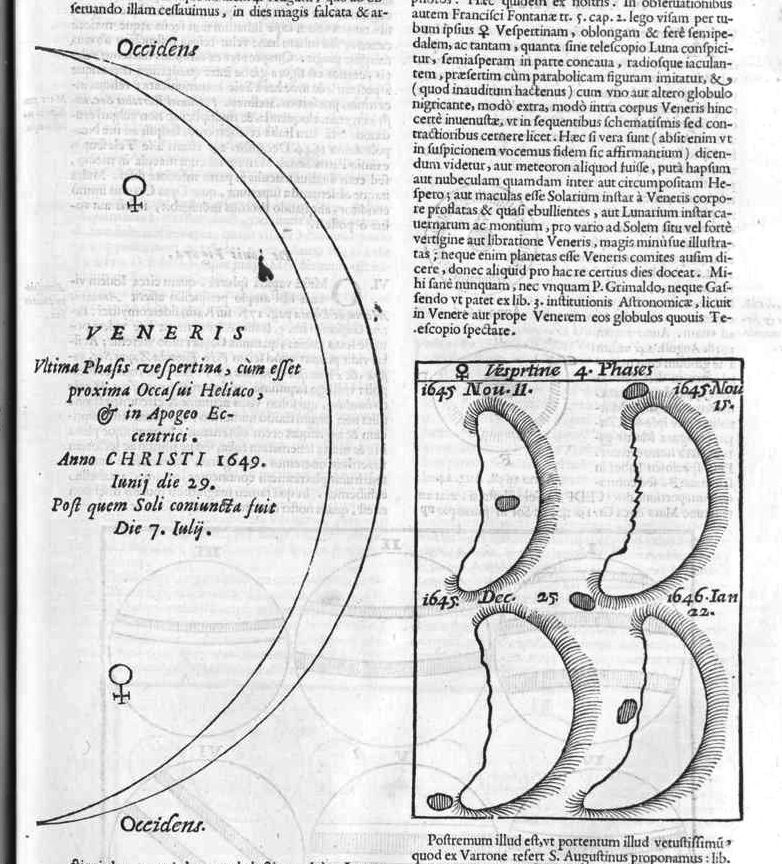
Meanwhile Venus shows phases, like the Moon. Galileo observed them through his telescope at the end of 1610 and, to stake his claim without giving anything away, sent Kepler a Latin anagram: ‘Haec immatura a me iam frustra leguntur o.y.’, these unripe things are now read by me in vain. The key followed months later, ‘Cynthiae figuras aemulatur mater amorum’: the mother of love imitates the shapes of Cynthia, that is, of the Moon. He published his observations in 1613. A Venus running through the full set of phases was something the Ptolemaic system did not allow. In 1651 Riccioli drew its crescents on the plate at the top of this article.
November 2026: Phosphoros over Brussels
On 1 November Venus rises at , 53 minutes before the Sun. Don’t bother looking that morning: barely 3% lit, it is lost in the glow of dawn, less than 3 degrees up half an hour before sunrise. Each morning it gains ground, about ten minutes a day at the start of the month, three by the end. On 30 November it rises at , nearly four hours before the Sun, and stands 24 degrees up half an hour before sunrise. Look for it in the east-south-east, then more and more towards the south-east as the month goes on.
On a thin crescent Moon, 4% lit, climbs alongside it. At , seen from Brussels, about 2.3 degrees separate them, with Venus 8 degrees above the horizon and the Moon a little higher. You will need a clear horizon towards the east-south-east; the Sun rises three quarters of an hour later.
On Venus passes close to Spica, the ear of wheat in Virgo’s hand. At , seen from Brussels, about 1.2 degrees separate them, a dozen degrees above the horizon; the day before and the day after, the gap is almost the same. Venus is then more than a hundred and fifty times brighter than Spica. The evening star that is no star outshines the real star, and they have met more closely before: on 10 November 1783 Venus actually covered Spica. The next occultation is expected on 2 September 2197.
Venus reaches its greatest brilliancy at the end of the month, around magnitude −4.9, on a long plateau from 22 to 29 November according to our calculations. It is then only a fifth to a quarter lit: through a telescope it is a thick crescent, like those Riccioli drew. Its greatest distance from the Sun, nearly 47 degrees, comes on 3 January 2027.
One precaution, always the same: do not hunt for it with binoculars or a telescope once the Sun is up or about to rise. In November Venus is still close to the Sun, and a Sun that strays into an instrument by mistake is unforgiving.
Venus in five dates
Phosphoros at dawn
Venus rises 53 minutes before the Sun on 1 November and nearly four hours before it on the 30th. The Moon is about 2.3 degrees away on the 7th around 07:00, Spica 1.2 degrees away on the 9th around 07:15, Brussels time. Greatest brilliancy around −4.9 at the end of the month.
The Venus tablet
Under King Ammisaduqa, in Babylon, 21 years of appearances and disappearances of Venus are recorded. Date disputed; copy from Nineveh in the British Museum, K.160.
The phases of Venus
Galileo sees through his telescope that Venus has phases, like the Moon, and announces it to Kepler in an anagram. He publishes them in 1613.
Sense and reference
Gottlob Frege takes the evening star and the morning star as his example: one reference, two senses.
Greatest distance from the Sun
Venus stands nearly 47 degrees west of the Sun, the farthest it gets during this morning apparition.
Frequently asked questions
- Are the morning star and the evening star the same body?
- Yes. Both are Venus, sometimes east of the Sun and visible after sunset, sometimes west of it and visible before sunrise. The Greeks called it Hesperos in the evening and Phosphoros in the morning, the Romans Vesper and Lucifer.
- Is the evening star a star?
- No. Venus is a planet with no light of its own, reflecting sunlight. According to NASA it is the brightest object in the sky after the Sun and the Moon. French calls it ‘l’étoile du berger’, the shepherd’s star, which is just as wrong.
- Who discovered that it was the same body?
- The Greeks credited Pythagoras or Parmenides, depending on the author; Diogenes Laertius gives both versions. Long before them, Babylonian astronomers were already following Venus as a single object, on a tablet from the reign of Ammisaduqa.
- Where can I see Venus in November 2026 from Belgium?
- In the morning before sunrise, low in the east-south-east and later in the south-east, in front of the stars of Virgo. From Brussels it rises 53 minutes before the Sun on 1 November and nearly four hours before it on the 30th. On the 7th around 07:00 the Moon is about 2.3 degrees from it; on the 9th around 07:15, Spica is 1.2 degrees away.
- When is Venus at its brightest?
- For this morning apparition, around magnitude −4.9 at the end of November 2026, roughly from 22 to 29 November, according to our calculations. NASA gives −4.8 as the planet’s maximum brightness. Only the Sun and the Moon are brighter.
- Does Venus rule Taurus and Libra?
- That is an astrological tradition, presented here as such: in it Venus is the ruler of those two signs. It says nothing about the real sky, where Venus spends November 2026 in front of the stars of Virgo.
