
7 November, not the 1st
Astronomical autumn begins at the equinox, on at , and ends at the winter solstice, on at . In between, the Sun covers a quarter of the ecliptic, from 180 to 270 degrees of longitude. It reaches the midpoint, 225 degrees, on at . At sunrise on All Saints’ Day it still has a good six days to go.
The calendar says 1 November. The Sun replies: the 7th.
The middle of the angle is not even the middle of the time: from the equinox to 225 degrees takes 45.4 days; from there to the solstice, 44.5. The Earth is picking up speed, since it comes closest to the Sun in early January, and that is where it moves fastest along its orbit. Between 2020 and 2030, our calculations always put this midpoint on 6 or 7 November.
Daylight does not wait for the 7th to dwindle. In Brussels the day lasts 12 hours 9 minutes at the equinox and only 7 hours 56 minutes at the solstice. On 1 November the Sun rises at and sets at : 9 hours 43 minutes of daylight. By the 7th, 9 hours 23 minutes remain. At the astronomical midpoint of autumn, then, the day has already lost 2 hours 46 minutes of the 4 hours 13 minutes it loses in all.
Four festivals in the middle of the seasons
Medieval Ireland did not count its year by the solstices. Samhain appears in the earliest Irish literature, from the 9th century, and the tale Tochmarc Emire, ‘The Wooing of Emer’, lists it first among the four seasonal festivals, whose names the hero Cú Chulainn explains. In Kuno Meyer’s English translation of 1888, Samuin is ‘the end of summer’; Oimolc, our Imbolc, ‘the beginning of spring’; Brón Trogaill, on 1 August, ‘Lammas-day, viz., the beginning of autumn’. That leaves Beltine, on 1 May.
According to Dáithí Ó hÓgáin, the Irish year had two halves: summer from Bealtaine, 1 May, and winter from Samhain, 1 November. And since the Celtic day began at sunset, Samhain opened on the evening of 31 October.
England kept the pattern. Between its four quarter days, Lady Day (25 March), Midsummer Day (24 June), Michaelmas (29 September) and Christmas Day, fall Candlemas (2 February), May Day (1 May), Lammas (1 August) and All Hallows (1 November): the cross-quarter days, so called because they fall about halfway into each quarter. Scotland kept its own term days, Martinmas (11 November) among them, until an Act of 1990 moved them to the 28th of February, May, August and November.
The Chinese calendar makes the same cut, but follows the real Sun. It divides the ecliptic into 24 solar terms, spaced 15 degrees apart. At 225 degrees falls Lidong, 立冬, ‘winter commences’, usually on 7 November. Lichun, Lixia and Liqiu open spring, summer and autumn in the same way, around 4 February, 6 May and 8 August: each time two to seven days after the round dates of Ireland and England. In China, winter begins exactly halfway through our autumn.
Samhain: what is known, and what is told
You will read almost everywhere that Samhain was the Celtic New Year. The idea goes back to John Rhys and James Frazer. The historian Ronald Hutton, in The Stations of the Sun (1996), calls the evidence flimsy and finds that ‘the medieval records furnish no evidence that 1 November was a major pan-Celtic festival’. A festival of the dead? That was Frazer’s view. Hutton finds no evidence that it began as one, though he grants that it was a time when supernatural forces were to be guarded against. Samhain, writes the historian Nicholas Rogers, ‘did not offer much in the way of actual practices, save in its fire rites’; most Halloween customs grew up around All Saints’ and All Souls’ Days.
Older than the Irish texts, the Gaulish calendar of Coligny, a bronze plaque from the late 2nd century found in the French department of Ain in 1897, names its first month SAMONIOS and bears the notation TRINOX SAMONI, ‘three nights of Samon’. Some read Samhain into it; others, a summer festival. The meaning is disputed, and the plaque says nothing about 1 November.
As for the eight-festival ‘Wheel of the Year’, solstices and equinoxes included, it is a modern construction: the phrase was in use among British neopagans by the mid-1960s. No Celtic festival is recorded at either solstice or at the autumn equinox. Nor do the Irish texts say anywhere that Samhain was set by the Sun. That 1 November lies close to the astronomical middle of autumn is a modern observation, not an intention anyone can pin on the druids.
Why All Saints’ Day falls on 1 November
The feast of all the saints was not born in November. On 13 May 609 or 610, Pope Boniface IV dedicated the Pantheon in Rome to the Virgin Mary and all the martyrs. Gregory III (731-741) later consecrated an oratory in Old St Peter’s to all the saints, on a 1 November according to some sources, on a 12 April according to others. By 800, churches in Gaelic Ireland and Northumbria kept a feast of all saints on 1 November. In 835, at the instance of Pope Gregory IV, Louis the Pious made it a holy day of obligation throughout the Frankish Empire.
Frazer believed the Church chose the date because of Samhain. Hutton sees a Germanic rather than a Celtic idea, and points to an Irish feast of all saints on 20 April, while other evidence puts it on 1 November. The sources disagree; the question remains open.
2 November has another origin. Odilo, abbot of Cluny, who died in 1048, ordered the commemoration of all the faithful departed to be held every year in the monasteries of his congregation; tradition dates the decision to 998. In Belgium, All Saints’ Day is one of ten public holidays set by the law of 4 January 1974, so families visit graves on the 1st, a day off, rather than the 2nd, and have brought chrysanthemums since the 19th century.
Halloween carries All Saints in its name: it is the Lowland Scots form of ‘All Hallows’ Eve’, the night before All Saints’ Day, which Robert Burns put into verse in 1785. In Ireland, Scotland and Northern England people carved turnips; emigrants to North America switched to the pumpkin, larger and softer.
Scorpio in the papers, Libra in the sky
For the horoscopes, All Saints’ Day falls in Scorpio: the Sun entered the sign on at and stands 9 degrees into it on 1 November. The middle of autumn, 225 degrees, is exactly the 15th degree of Scorpio, the centre of the sign. Pure geometry: the four midpoints of the seasons fall at the centres of Taurus (45 degrees), Leo (135), Scorpio (225) and Aquarius (315), the four signs that astrological tradition calls ‘fixed’.
Look up, and the scenery changes. Until the afternoon of 31 October the Sun stands in front of the stars of Virgo. It then moves in front of Libra, less than two hours before it sets and the night of Samhain begins. It only reaches the constellation of Scorpius on 23 November, for barely a week before Ophiuchus. The true middle of autumn, on 7 November, therefore plays out in front of Libra. Signs are twelve equal slices of 30 degrees; constellations have borders, drawn in 1930 by Eugène Delporte at Uccle.
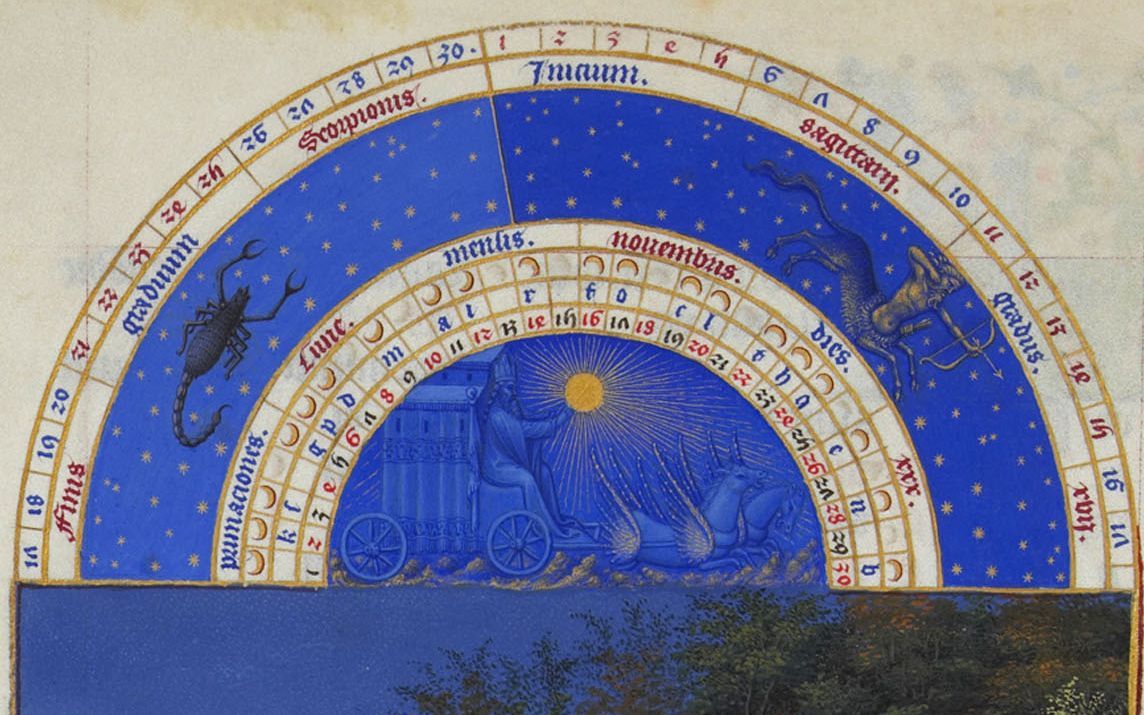
Fifteenth-century illuminators liked to set the learned sky above the season. In the Très Riches Heures du duc de Berry, each month of the calendar is crowned by an astronomical half-circle: Apollo in his chariot, the signs against a starry sky, the degrees of each sign. Beneath November’s, in a miniature painted by Jean Colombe around 1485-1486, a swineherd knocks down acorns for his pigs. He is celebrating nothing; he is feeding his animals. At on Saturday 7 November 2026, none of our calendars marks anything at all. Yet that is the exact moment.
Autumn 2026 in five dates
Middle of autumn
The Sun reaches 225 degrees of longitude at 10:52 Brussels time: the 15th degree of Scorpio. In China it is Lidong, ‘winter commences’.
Autumn equinox
The Sun reaches 180 degrees at 02:05 Brussels time. Day length: 12 hours 9 minutes.
Samhain eve
In the afternoon the Sun leaves the stars of Virgo for those of Libra. At sunset, in medieval Ireland, the feast of Samhain began.
All Saints’ Day
Public holiday in Belgium. The Sun is 9 degrees into the sign of Scorpio, in front of Libra. Sunrise 07:34, sunset 17:17.
Winter solstice
The Sun reaches 270 degrees at 21:50. Day length in Brussels is down to 7 hours 56 minutes. Astronomical winter begins.
Frequently asked questions
- Why is All Saints’ Day said to be the middle of autumn?
- Because 1 November falls roughly halfway between the equinox of 23 September and the solstice of 21 December. The exact midpoint, when the Sun reaches 225 degrees of longitude, comes on 7 November 2026 at 10:52 Brussels time.
- Is Samhain the ancestor of Halloween?
- Partly, perhaps, for the atmosphere and the bonfires. The name comes from All Hallows’ Eve, the night before All Saints’ Day, and most of the customs, according to the historian Nicholas Rogers, grew up around All Saints’ and All Souls’ Days.
- Was All Saints’ Day put on 1 November to replace Samhain?
- That was James Frazer’s thesis, and it is disputed. The date was fixed between Rome and the Frankish Empire: by Gregory III in the 8th century according to some sources, then by Louis the Pious in 835, at the instance of Gregory IV. Ronald Hutton sees a Germanic rather than a Celtic idea.
- Is the Sun in Scorpio on All Saints’ Day?
- In the sign, yes, since 23 October 2026. In front of the stars, no: it has stood in front of the constellation Libra since the afternoon of 31 October and only reaches Scorpius on 23 November.
- When does winter begin?
- It depends who is counting. On 1 November for medieval Ireland, on 7 November 2026 for the Chinese calendar (Sun at 225 degrees), on 1 December for meteorologists such as Belgium’s Royal Meteorological Institute, and on 21 December 2026 at 21:50 for astronomers, at the solstice.
