
A legend made in Paris, 1775
In 1775 Jean-Sylvain Bailly published his Histoire de l’astronomie ancienne. In a passage on the Persians he wrote that ‘one reads in their books’ that there were once four stars marking the four cardinal points. Which books? He does not say, not there at least. The Avesta, the Zoroastrian scriptures, had been translated into French by Anquetil-Duperron in 1771.
The four guardians of the sky were recruited in 1775.
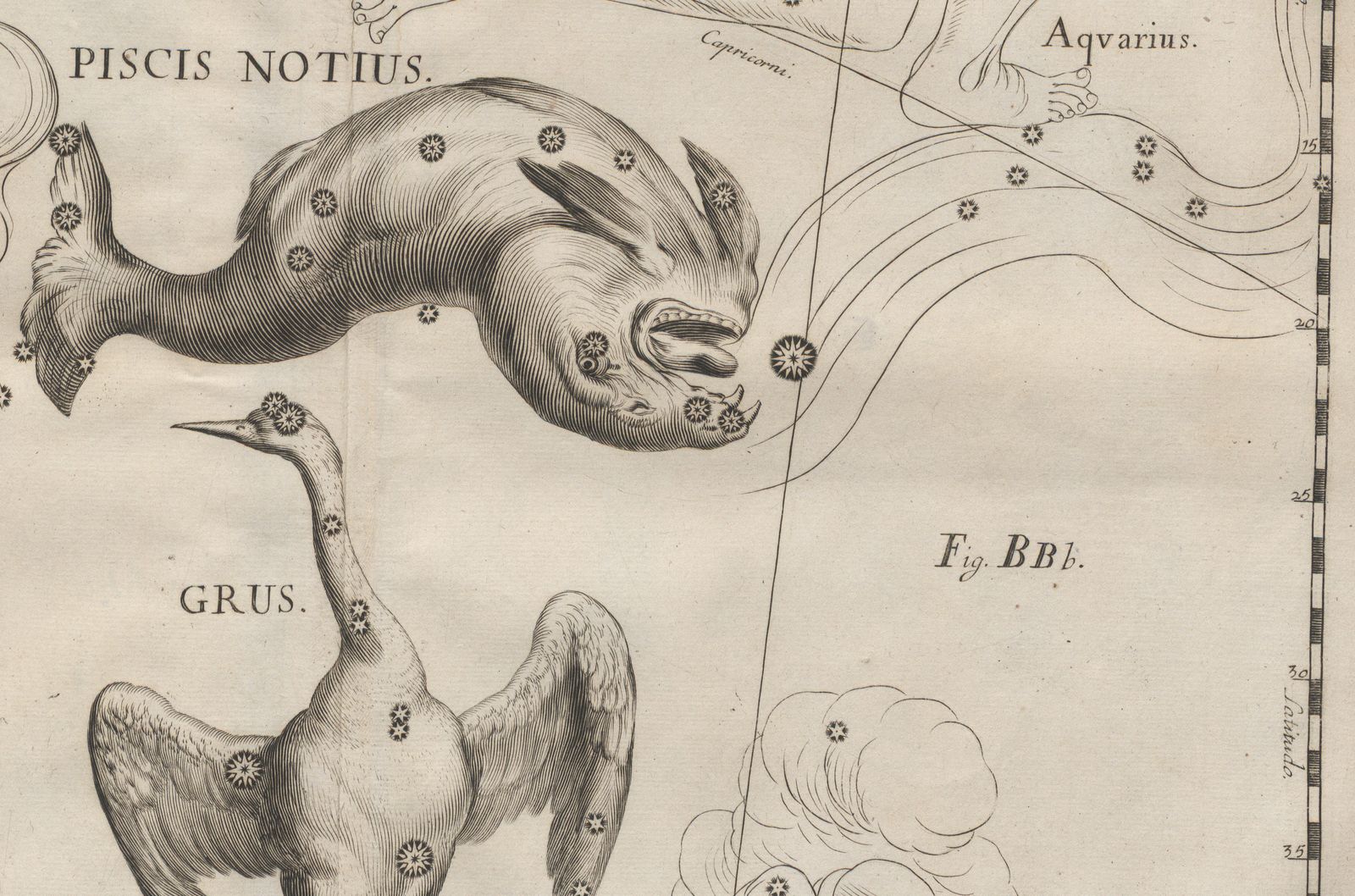
Then Bailly did the sums. Around 3000 BC, he wrote, ‘the eye of the Bull’ and ‘the heart of the Scorpion’, that is Aldebaran and Antares, stood exactly at the two equinoxes; ‘the heart of the Lion’, Regulus, and the Southern Fish, whose mouth is Fomalhaut, very close to the two solstices. Four bright stars, one at each corner of the year: a lovely idea, and it would travel far.
The word ‘royal’ was not there yet. It came from Charles-François Dupuis, whose Origine de tous les cultes appeared in 1795. In the nineteenth century François Arago and then Camille Flammarion repeated the story in their popular astronomy books without checking it. In 1899 the American Richard Hinckley Allen made Regulus ‘the leader of the Four Royal Stars of the ancient Persian monarchy, the Four Guardians of Heaven’. By the early twentieth century the legend was a favourite in astronomical circles.
What the Persian text says
The Iranian text most often invoked is the Bundahishn, the ‘primal creation’, a compendium of Zoroastrian cosmology in Middle Persian whose chapters mostly date from the eighth and ninth centuries AD. It does know four guardians of the sky. In Edward William West’s translation for the Sacred Books of the East, Tishtar is ‘the chieftain of the east’, Sataves that of the west, Vanand that of the south, and Haptoring ‘the chieftain of the north’.
None of these names belongs to one of the four stars. West himself ventures identifications in a footnote. There is ‘no doubt’, he writes, that Haptoring, chieftain of the north, is Ursa Major, the Great Bear; Tishtar is usually taken to be Sirius. For the other two he cautiously suggests Fomalhaut and Antares, and other writers have seen Vanand as Altair, Vega or a star in Scorpius. Counting generously, then, the Persian text shares two stars with Bailly’s list. Aldebaran and Regulus are nowhere in it.
To make the modern version fit, the text had to be bent. According to Allen, Flammarion made Fomalhaut guardian of the north, Aldebaran of the east and Regulus of the south, which leaves the west to Antares. Fomalhaut as warden of the north: from Brussels it never climbs ten degrees above the southern horizon.
What the calculation confirms
On the geometry, Bailly was not wrong. We redid his calculation with the precession of the equinoxes, the slow wobble of the Earth’s axis that shifts the stars by about one degree every 72 years relative to the equinoxes. Around 3000 BC Aldebaran lay 0.6 degrees from the spring equinox point and Antares 0.7 degrees from the autumn one. For those two, his ‘exactly’ holds.
The solstices are less tidy. Regulus was then 9 degrees from the summer solstice, Fomalhaut 6 degrees from the winter one. And Fomalhaut lies 21 degrees below the ecliptic: it ‘marks’ the solstice only in longitude, far from the Sun’s path. Each star had its exact moment, but not the same one: around 3050 BC for Antares, around 2350 BC for Regulus, seven centuries later. The four were never in place together.
Then there is the date. Around 3000 BC there was no Persian Empire: Cyrus the Great founded it in 550 BC, nearly 2,500 years later. No Persian document supplies the date; precession does. Bailly even took it as confirmation that a Persian astronomy already existed by about 3100 BC.
The only real king: Regulus
Only one of the four bears an ancient royal title, and it is Babylonian. The astronomers of Babylon called Regulus Sharru, ‘the King’. Ptolemy calls it Basiliskos, ‘little king’, which Latin renders as Regulus. The Latin name is said to date from the early sixteenth century; Allen credits Copernicus and insists that it owes nothing to the consul of the First Punic War.
The other three have descriptive names, not ranks. Aldebaran comes from the Arabic al-dabarān, ‘the follower’, because it seems to follow the Pleiades. Antares is Greek for ‘rival of Ares’, red like the planet Mars; its traditional Arabic name means ‘heart of the scorpion’. Fomalhaut, from fam al-ḥūt, is ‘the mouth of the fish’. Bailly himself named them by animal parts: an eye, two hearts, a fish. Hardly a royal court.
Antares: Scorpius in the sky, Sagittarius by sign
Since 3000 BC the stars have slipped by nearly 70 degrees, and the four ‘guardians’ have nothing left to guard. Aldebaran now sits around 10 degrees into the sign of Gemini, Regulus has just entered Virgo, and Fomalhaut is around 4 degrees into Pisces.
With Antares the gap becomes a paradox. The Sun entered the sign of Scorpio on at . Antares, the heart of the constellation Scorpius, is not in it: its longitude places it around 10 degrees into the sign of Sagittarius. Signs are twelve equal slices of 30 degrees, counted from the spring equinox; constellations are regions of sky, bounded in 1930 by Eugène Delporte at Uccle.
The Sun will not pass close to Antares until , 4.6 degrees north of the star. By then it will be in the sign of Sagittarius and in front of the constellation Ophiuchus. The Scorpion’s star meets the Sun in neither the sign nor the constellation that bears its name.
Three out of four, this week in Brussels
The late-October sky shows three of them, if you stay up and have a clear view to the south. Fomalhaut opens the evening. On Saturday 24 October it stands due south at , less than 10 degrees up, and sets a little over three hours later. A hill or a top floor will help.
Aldebaran rises in the east-north-east at and stays up all night; around 03:00 winter time it stands more than 55 degrees high in the south.
In the night from Saturday to Sunday, clocks go back an hour at 03:00. That night it is therefore twice. Regulus rises in the east the first time round, still on summer time. A day later it rises at , and by , winter time, it is already some 40 degrees up in the south-east, well before dawn washes it out.
Antares is missing. On 23 October it was only 6 degrees above the south-western horizon at sunset, drowned in twilight, and it set at . Never point binoculars at the horizon until the Sun has set. In early December the Sun passes Antares by.
The four at a glance
Aldebaran
Magnitude 0.87 in the IAU catalogue, varying between 0.75 and 0.95: usually the brightest of the four. A giant, 65 or 67 light years away depending on the measurement. It lies 5.5 degrees from the ecliptic and is sometimes hidden by the Moon; the last series of occultations ran from 2015 to 2018.
Regulus
Magnitude 1.36, about 79 light years away. At 0.465 degrees from the ecliptic, it is the bright star closest to the Sun’s path. The Moon occults it in series, roughly every 9.3 years.
Antares
A red supergiant, magnitude around 1 but variable, from 0.6 to 1.6. At about 550 light years it is the most distant of the four. Its radius is some 680 times the Sun’s.
Fomalhaut
Magnitude 1.17, only 25 light years away: the nearest of the four. A debris disc surrounds it at 133 astronomical units. ‘Fomalhaut b’, announced in 2008 as a planet, is now thought to be a cloud of debris from a collision.
Frequently asked questions
- What are the four royal stars?
- Aldebaran (Taurus), Regulus (Leo), Antares (Scorpius) and Fomalhaut (Piscis Austrinus). Since the eighteenth century they have been presented as the ‘guardians of the sky’ of the ancient Persians.
- Did the Persians really call them ‘royal’?
- There is no evidence that they did. The idea of the four stars comes from Jean-Sylvain Bailly (1775), the phrase ‘royal stars’ from Charles-François Dupuis (1795). The Bundahishn does name four chieftains of the sky, but the northern one is Ursa Major, and neither Aldebaran nor Regulus appears.
- Did they mark the equinoxes and solstices?
- Partly. Around 3000 BC Aldebaran and Antares were less than a degree from the equinoxes, but Regulus and Fomalhaut were 9 and 6 degrees from the solstices. The four were never in place at the same time, and precession has since moved them by nearly 70 degrees.
- Is Antares in the sign of Scorpio?
- No. It is the heart of the constellation Scorpius, but today it lies around 10 degrees into the sign of Sagittarius. The Sun passes close to it around 2 December, while standing in front of Ophiuchus.
- Can you see them from Belgium in late October?
- Three of the four: Fomalhaut in the evening, low in the south; Aldebaran all night; Regulus before dawn. Antares is lost in the glow of sunset.
