
A planet in the fast lane
Mercury goes round the Sun in 88 days, at nearly 47 kilometres per second: according to NASA, no planet is faster. The Earth, on the outer track, takes a year. Every 116 days on average, Mercury catches up and overtakes it on the inside, passing between the Earth and the Sun. This is inferior conjunction. This time it falls on , at .
Mercury is not going backwards. It is overtaking us.
Around that overtaking, the line from our eyes to Mercury swings backwards across the background stars, while the planet carries on in the same direction as ever. Astronomers like the motorway comparison. Overtake a lorry and it seems to slip backwards, though you are both heading the same way. Between Mercury and the Earth the effect works both ways. Seen from Mercury, it is our planet that goes retrograde.
The backward drift began on 24 October, when Mercury seemed to halt among the stars: the stationary point. It will end at the next one, on 13 November. Twenty days in all, for 16 degrees covered in reverse. A retrograde spell of Mercury lasts 22 days on average, 20 to 24 depending on the case. The exact hour of a station shifts by several hours depending on whether you measure it in right ascension or in ecliptic longitude; the date does not.
Scorpio among the signs, Libra in the sky
On 24 October, Mercury stood 21 degrees into the sign of Scorpio. By 13 November it will have backed down to 5 degrees. The whole loop fits inside that one sign, which the Sun entered on . For astrologers, then, this is a ‘Mercury retrograde in Scorpio’.
Look up, and the scenery changes. Mercury goes backwards in front of the stars of Libra, crosses into Virgo on and finishes its retreat there. It will not return to Libra until 19 November, and it reaches the constellation Scorpius only on 8 December, long after the loop is over. Signs are twelve equal slices of 30 degrees, counted from the spring equinox; constellations are regions of sky, bounded in 1930 by Eugène Delporte at Uccle.
In 2026 Mercury goes retrograde three times, each time with the same mismatch. From late February to late March, in the sign of Pisces, in front of Pisces and then Aquarius. From late June to late July, in the sign of Cancer, but entirely in front of Gemini. And now this one. The papers say Scorpio, the sky says Libra, then Virgo: both are right, they are simply not talking about the same thing.
From Babylonian tablets to epicycles
Mercury did not wait for the Sunday papers to get itself noticed. According to the historian Mathieu Ossendrijver, speaking to National Geographic, Babylonian astronomers probably recorded Mercury’s retrograde motion as early as the 7th century BC, and they had ‘a very clear mathematical understanding of that motion’. What they made of it, we do not know: the omen tablet devoted to Mercury is missing.
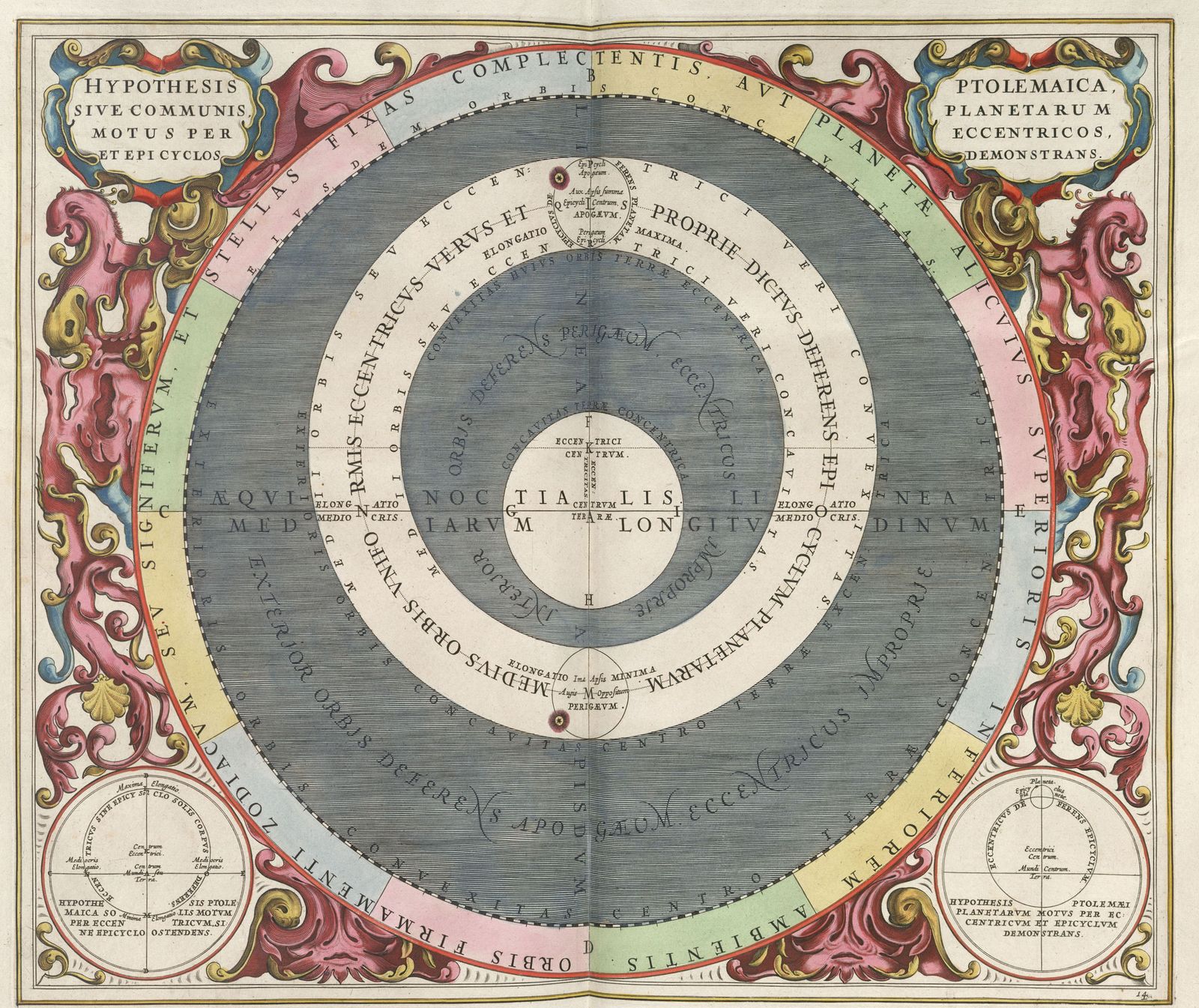
The Greeks held to a rule: heavenly bodies move on circles, at constant speed. How do you make a planet go backwards with that? You set it on a small circle, the epicycle, whose centre itself travels round a large circle, the deferent. When the planet runs along the inner side of its small circle, it seems to turn back. The idea is often attributed to Apollonius of Perga, at the end of the 3rd century BC; Hipparchus worked out the orbits a century later.
Around AD 150, Claudius Ptolemy gathered it all into the Almagest. In Book IX he sets himself the task of showing that all the apparent irregularities of the five planets arise from uniform circular motions. Book XII deals with stations and retrogradations, Mercury and Venus included. To account for changes in speed, Ptolemy adds one more point, the equant. The machinery is heavy, and it creaks, but it explains the retrograde motion of the five known planets.
Copernicus: the Earth is enough
In 1543, the year of his death, Nicolaus Copernicus published De revolutionibus orbium coelestium in Nuremberg. Aristarchus of Samos had already proposed putting the Sun at the centre around 240 BC; Copernicus turned it into a system. ‘In medio vero omnium residet Sol’, he writes in Book I: in the middle of all sits the Sun.
In the same chapter he reviews what the old astronomy had struggled to explain, among other things why the advance and retreat appear greater in Jupiter than in Saturn, and smaller than in Mars. His answer fits in one sentence: ‘Quae omnia ex eadem causa procedunt, quae in telluris est motu’. All of this proceeds from a single cause, which lies in the motion of the Earth. Copernicus no longer needs an epicycle to make the planets go backwards: a moving Earth is enough.
That does not rid him of epicycles. His system keeps circular orbits, uniform speeds and small epicycles; he drops Ptolemy’s equant, but at the cost of extra epicycles, and whether it was really simpler is still argued over. Only Kepler’s ellipses, published in 1609 and 1619, would do away with them. Copernicus also gives Mercury a period of eighty days, ‘octuaginta dierum spacio’; the modern value is 88. Eight days short, nearly a tenth of a Mercurian year: the fastest planet in the system was still slipping away from its pursuers.
And your emails?
Ancient astrology already knew Mercury retrograde. In horary astrology, which casts the sky for the moment a question is asked, a typical phrase, according to the historian of astrology Nicholas Campion, quoted by Time, was ‘nothing will come of it’.
The popular version is far younger. The birthday horoscope reached the press in 1930, when R. H. Naylor published one in the Sunday Express. For Campion, the meaning widened in the 1980s: ‘People started to apply it to everything.’ Crashed computers, stray emails, contracts signed askew: no serious source says exactly where that list comes from. Time notes only that Google searches for ‘is Mercury in retrograde’ climbed steeply from 2009. The planet, to be fair, did not choose its name: Mercury was the Roman god of trade, communication and messages.
National Geographic sums up the scientific view: the link between astrology and events on Earth ‘is largely refuted as pseudoscience’. The mechanics hold no mystery. On the day of conjunction, Mercury will be 0.674 astronomical units from us, about 100 million kilometres, slipping 0.37 degrees south of the Sun without crossing its disc. If an email goes to the wrong person before 13 November, the shortest trail leads to the keyboard.
Seeing it from Brussels
Not at the moment. This Sunday, 25 October, Mercury stands only 2 degrees above the south-west horizon at sunset and sets at , some twenty minutes after the Sun. It is nearly 20 degrees from the Sun, all the same. But on autumn evenings, at our latitude, the Sun’s path lies very flat along the horizon, and the planet stays at rooftop height. On 4 November, Mercury rises and sets with the Sun, to within a few minutes: invisible.
It will return at dawn, where the path stands much steeper at this time of year. Its greatest western elongation falls on , 20 degrees from the Sun. From 14 to 26 November, roughly between and , look for it about ten degrees above the east-south-east horizon, some forty minutes before sunrise. At a magnitude close to 0, it is easy to spot with the naked eye if the horizon is clear.
You need an open view to the east: a top floor, a hill, a field. Binoculars help to find it in the dawn glow, but put them away before the Sun comes up: a glimpse of the Sun through any optics can damage the eye for good.
The loop in five dates
Inferior conjunction
Mercury passes between the Earth and the Sun, 0.37 degrees south of it: no transit across the solar disc this time. Distance: 0.674 astronomical units, about 100 million kilometres. Invisible, lost in daylight.
First station
Mercury halts 21 degrees into the sign of Scorpio, in front of the stars of Libra, then begins to go backwards.
Back in Virgo
Moving backwards, Mercury recrosses the boundary drawn in 1930 between Libra and Virgo.
Second station
End of the retreat, 5 degrees into the sign of Scorpio, in front of Virgo. Mercury resumes direct motion.
Greatest western elongation
Mercury stands 20 degrees west of the Sun: the best time to catch it at dawn from Brussels.
Frequently asked questions
- Does Mercury really go backwards?
- No. It always orbits the Sun in the same direction. Seen from the Earth, it appears to go backwards when it overtakes us on the inside, around the inferior conjunction of 4 November 2026.
- When is Mercury retrograde in 2026?
- Three times: from late February to late March, from late June to late July, and from 24 October to 13 November. This last loop lasts about twenty days.
- In which sign and in front of which constellation does Mercury go backwards?
- In the sign of Scorpio from start to finish, but in front of the stars of Libra, then Virgo from 8 November. Mercury reaches the constellation Scorpius only on 8 December.
- Can I see it from Brussels?
- Not in late October: it sets about twenty minutes after the Sun. From 14 to 26 November, yes, at dawn, around 07:20 to 07:40, about ten degrees above the east-south-east horizon.
- What were epicycles for?
- To make planets go backwards using circles travelled at constant speed: the planet turned on a small circle carried by a large one. With Copernicus, in 1543, the Earth’s motion explains the retreat; yet he keeps circles and small epicycles, which only Kepler’s ellipses would make unnecessary.
- Does Mercury retrograde affect emails?
- No effect has been established. The link between astrology and events on Earth ‘is largely refuted as pseudoscience’, writes National Geographic. According to the historian of astrology Nicholas Campion, people started applying it to everything in the 1980s; exactly where the list of breakdowns and contracts comes from remains unclear.
