
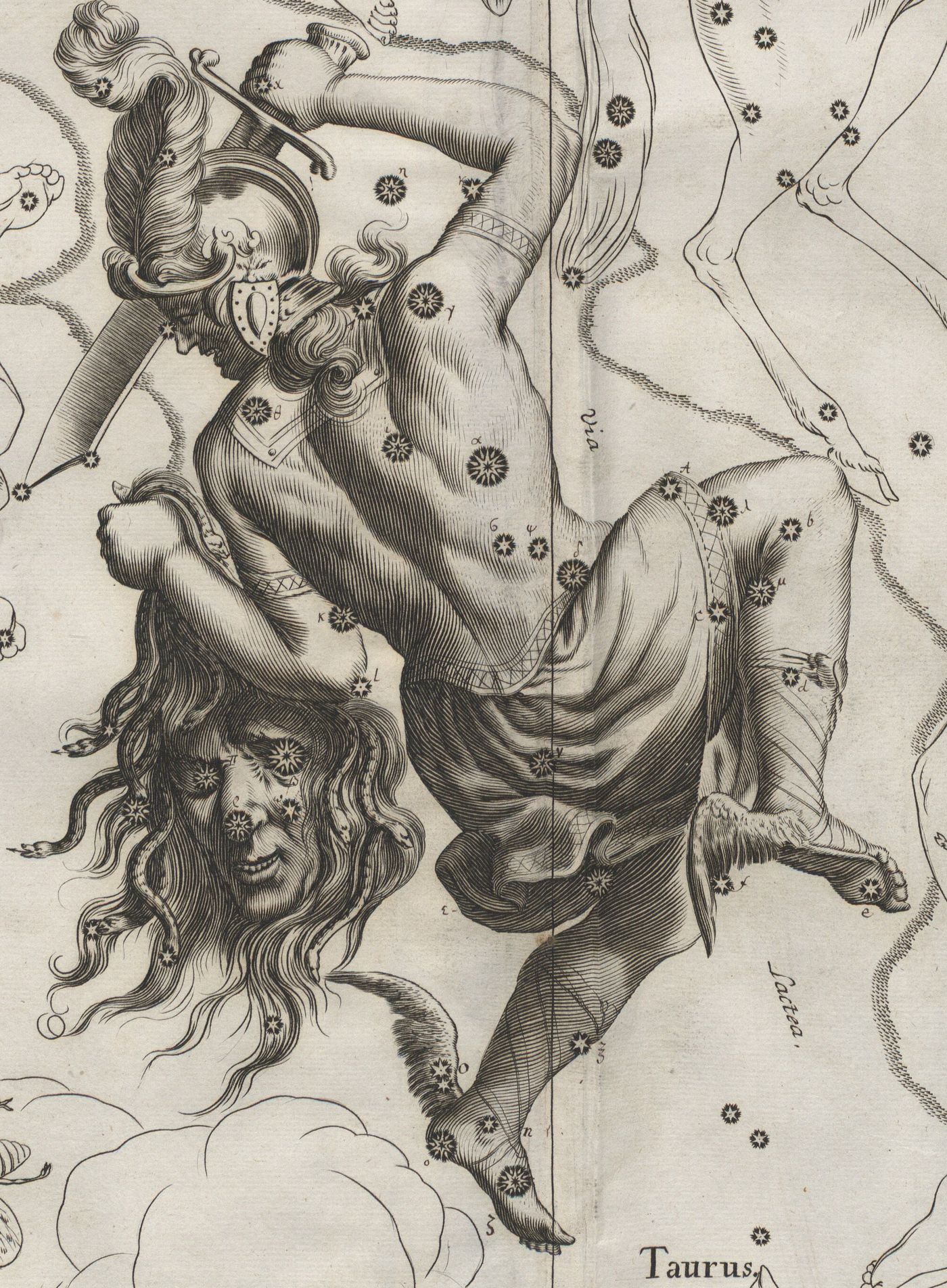
The head of the ghoul
Algol is a translation. The Greeks saw in these stars Perseus holding up the Gorgon’s head, and the brightest star of the head became, for Arab astronomers, raʾs al-ghūl, ‘the head of the ghoul’, or of the demon. English turned it into the ‘Demon Star’. As early as the 2nd century Ptolemy calls it ‘the Gorgon of Perseus’ in the Tetrabiblos and links it with death by beheading.
A star with a demon’s name, which lowers its eyes every 2 days and 21 hours.
Latin could not make up its mind. The American scholar Richard Hinckley Allen, in 1899, attributes Caput Gorgonis, ‘the Gorgon’s head’, to Hyginus, and credits Gorgoneum Caput to Vitruvius. There is also Gorgonea Prima, ‘the first of the Gorgon’, and, in the 16th century, Caput Larvae, ‘the spectre’s head’. As late as 1783 John Goodricke wrote of ‘the bright Star in the Head of Medusa, called Algol’. The Arabic name won in the end: since 30 June 2016 Algol has been the official name of Beta Persei, approved by the International Astronomical Union’s Working Group on Star Names.
In China the star is 大陵五, the fifth star of the Great Mausoleum, an asterism of eight stars in the lunar mansion of the Stomach. The astronomical treatise of the Jin shu says these eight stars ‘preside over great mourning’ (our translation). Allen gave it an even grislier Chinese name, ‘the Piled-up Corpse’, which in fact belongs to its neighbour Pi Persei. The bad reputation, at least, is well documented: according to Allen, astrologers held Algol to be ‘the most unfortunate, violent, and dangerous star in the heavens’. A reported tradition, not a weather forecast.
Perseus and the Gorgon
King Polydectes of Seriphos sends Perseus, son of Zeus and Danaë, to fetch him the head of Medusa. In Apollodorus the adventure begins with a theft. The Graeae, three sisters, share a single eye and a single tooth. Perseus seizes them and gives them back only once the sisters have shown him the way to the nymphs. The nymphs hand over winged sandals, a bag, the kibisis, and the helmet of Hades, which makes its wearer invisible.
Hyginus tells the same expedition with different suppliers: Mercury lends the winged sandals and the hat, Vulcan a knife of adamant. That leaves the small matter of approaching the sleeping Gorgons without meeting their gaze. Perseus, says Apollodorus, keeps his eyes on their reflection in a bronze shield, while Athena guides his hand. From the severed neck leaps Pegasus, the winged horse.
Ovid adds two scenes in the Metamorphoses. On an Ethiopian shore Perseus lays the head on a bed of leaves and fresh seaweed, which hardens at its touch: ever since, he writes, coral has hardened in the air. He also explains the snakes. Medusa was famed for her beauty, above all for her hair. Neptune raped her in Minerva’s temple, it is said, and it is Medusa the goddess punishes, by turning her hair into snakes. According to Hyginus, the head ends up on Minerva’s breastplate; in Ovid, the goddess wears the snakes on her breast. In the sky, Perseus keeps it in his hand.
A whole family in the sky
That Ethiopian shore is the kingdom of Cepheus and Cassiopeia. Their daughter Andromeda is chained there to a rock, offered to the ketos, a sea monster which Poseidon has sent along with a flood tide. Everyone blames Cassiopeia, just not for the same thing. In Apollodorus she challenged the Nereids in beauty; Hyginus, in his work on astronomy, credits that boast to Euripides, Sophocles ‘and many others’. In his Fabulae, however, it is her daughter’s beauty that Cassiopeia praises. Ovid spares us the details: the innocent Andromeda pays for ‘her mother’s tongue’, by decree of Ammon, ‘the Unjust’.
Perseus kills the monster and frees the princess. Phineus, brother of Cepheus and Andromeda’s betrothed, plots against the marriage with his supporters; Perseus shows them the Gorgon, and they turn to stone. In the Fabulae the betrothed is called Agenor.
Then, according to Hyginus, the whole family goes up to the sky. The gods number Cepheus among the constellations. Andromeda owes her place to the favour of Minerva, for the valour of Perseus; Perseus himself to his nobility and the unusual nature of his conception (Zeus, as Ovid tells it, came to Danaë as a shower of gold). Cassiopeia is there too, but as a punishment: seated on her chair, for her impiety, she seems to be carried round by the turning sky lying on her back. Perseus is one of Ptolemy’s 48 constellations. The monster has one too, Cetus, which will get an article of its own.
An eighteen-year-old in York
No ancient text we have read says that Algol changes in brightness. The first named astronomer to record it is Geminiano Montanari, professor of mathematics in Bologna, around 1667. A century later John Goodricke knew of that observation only from a Latin sentence in Du Hamel’s history of the Académie des sciences, under the year 1695. Montanari testifies there that the bright star of Medusa changes magnitude from year to year, and Maraldi saw it in 1694 now of the fourth, now of the third, now of the second magnitude.
Goodricke was born in Groningen in 1764 and had been deaf since early childhood. In York he became friends with his neighbour Edward Pigott, an astronomer and a distant cousin. ‘The first time I saw it vary was on the 12th of November 1782, between eight and nine o’clock at night’: that evening Algol looked to be of the fourth magnitude, and the very next day of the second, its usual brightness. On 28 December he watched it climb from the fourth to the second magnitude in three hours, and was ‘much surprized’. He told Pigott at once, whose observations agreed with his own.
On 12 May 1783 he wrote to Anthony Shepherd, Plumian Professor at Cambridge, asking him to present his observations to the Royal Society, where they were read on the 15th. Goodricke first gives a period of about two days and twenty-one hours, then, after his table of observations, ‘about every two days and nearly twenty hours and three quarters’. He ventures two explanations: a large body revolving round Algol and passing in front of it, or a star turning on itself and periodically showing a side covered with spots. Then he reins himself in. His aim is to communicate ‘facts, not conjectures’.
The Royal Society awarded him the Copley Medal for 1783, jointly with Thomas Hutchins. From 1781 to 1786 he and Pigott followed other variables, among them Beta Lyrae and Delta Cephei, the prototype of the Cepheids. On 16 April 1786 Goodricke was elected a Fellow of the Royal Society. He died four days later, probably of pneumonia, aged 21, without ever learning of it.
An eclipse, not a wink
Goodricke’s first guess was the right one. Proving it took a century. In 1881 Pickering showed that Algol is an eclipsing binary; in 1889 Vogel found in its spectrum the periodic Doppler shifts of a star orbiting another. In 1910 Stebbins, with a selenium cell, made it the subject of the first photoelectric study of a variable star.
Algol, 94 light years away, is a system of at least three stars. The two that eclipse each other orbit in 2.867 days: a hot B8 star of 3.2 solar masses and a K0 subgiant, cooler and fainter, of 0.7 solar masses. When the subgiant passes in front of its companion, the brightness drops from magnitude 2.1 to 3.4; the eclipse is partial and lasts about ten hours. A third star, of type F1, circles the pair in about 680 days.
To the naked eye, then, Algol fades from the brightness of Almach, Gamma Andromedae, to that of a very ordinary star, then comes back, roughly every 2 days and 21 hours. We give no exact times of minimum: the lists published for this autumn contradict one another. The ‘Minima of Algol’ calculator published by Sky & Telescope offers some; check them against your own eyes.
Had the Egyptians seen it first? A team led by Lauri Jetsu and Sebastian Porceddu believes it can read a cycle of 2.850 days in the Cairo Calendar, an Egyptian calendar of lucky and unlucky days composed some 3,200 years ago. It attributes the cycle to Algol, whose period would then have been slightly shorter. In 2013 the team linked the star to ‘the Raging one’; in 2018, to Horus. Others have their doubts. In 2021 Krauss and Reijs published a critique under a pointed title: ‘Do Ancient Egyptian Almanacs Show Evidence of Celestial Recurrence?’. The hypothesis is published and disputed, and it is still a hypothesis.
Tonight over Brussels
Full darkness begins at and lasts until . Algol has long since risen: from Brussels it never sets. At its lowest, below the pole, it sinks to 1.9 degrees above the northern horizon, behind the nearest roof, then climbs again. This time that moment falls in broad daylight.
At Algol shines 46.5 degrees up in the east-north-east, at about the same height as Mirfak, the brightest star in Perseus. At it is 65 degrees up, in the east. It culminates at , due south, 80 degrees up, with the zenith only ten degrees further on. A reclining chair beats a stiff neck.
The Moon, waning gibbous and 62% lit, rises at in Gemini, about 61 degrees from Algol. It brightens the sky but hardly troubles a second-magnitude star. Last quarter falls on at .
To catch Algol fading, there is no need to wait for a precise minute. Compare it over several evenings with Almach, which normally matches it (magnitude 2.1), and with Mirfak, slightly brighter (1.8). On an eclipse night Algol looks clearly fainter than Almach, then catches up within a few hours. In August Perseus has another claim to fame: the Perseids, dust from Comet Swift-Tuttle that seems to stream out of the constellation.
Algol in five dates
Algol at its highest
Culmination due south at 01:11, Brussels time, 80 degrees up. Full darkness from 19:11 to 05:43; the Moon rises at 21:45, 62% lit.
Montanari
In Bologna, Geminiano Montanari notes that Algol’s brightness varies. Goodricke would know of it only from a sentence in Du Hamel, under the year 1695.
Goodricke sees it vary
In York, between eight and nine in the evening, Algol looks to be of the fourth magnitude. The next day it is back to the second.
The period before the Royal Society
Goodricke’s observations are read: about two days and twenty and three-quarter hours, with the idea of a large body revolving round the star.
An official name
The IAU Working Group on Star Names approves ‘Algol’ for Beta Persei, HR 936.
Frequently asked questions
- Why is Algol called the Demon Star?
- Its name comes from the Arabic raʾs al-ghūl, ‘the head of the ghoul’ or demon. It translates the Greek figure: the severed head of Medusa, which Perseus holds in his hand, and whose brightest star is Algol.
- Does Algol really blink?
- No. It drops from magnitude 2.1 to 3.4 during an eclipse lasting about ten hours, then recovers, roughly every 2 days and 21 hours. A cooler, fainter star passes in front of a hot, bright one.
- Can I see a minimum of Algol tonight?
- We give no time: the lists published for this autumn contradict one another. The ‘Minima of Algol’ calculator from Sky & Telescope gives some. The safest method is to compare Algol with Almach and Mirfak over several evenings.
- Where can I see Algol from Belgium?
- In the east in the early evening, climbing higher. On the night of 31 October to 1 November 2026 it culminates due south at 01:11, Brussels time, 80 degrees up. From Belgium it never sets.
- Who discovered that Algol varies?
- Geminiano Montanari noticed it around 1667. John Goodricke, deaf and aged 18, saw it vary on 12 November 1782 and announced its period in 1783, encouraged by his neighbour Edward Pigott.
