
Five an hour, in no hurry
The headline figure is modest. The American Meteor Society’s 2026 list, compiled from International Meteor Organization (IMO) data, gives both branches of the Taurids a zenithal hourly rate (ZHR) of 5. That is the number of meteors a single observer would see in an hour if the radiant were overhead and the sky showed stars down to magnitude 6.5. From Brussels the radiant never reaches the zenith, 61 degrees at most for the northern branch, and the real count is nearly always lower.
Five meteors an hour, at best. But they take their time.
What sets the Taurids apart is their pace. The southern ones enter the atmosphere at 28.5 km per second, the northern ones at 28.3, according to the same list. The Orionids, October’s shower, arrive at 66 km per second according to NASA: 2.3 times faster. Writing for the IMO, Robert Lunsford contrasts the Taurids’ ‘few nice slow meteors’ with the ‘swift Orionids’.
Their other speciality is fireballs, meteors born of grains larger than usual. ‘The Southern Taurids are rich in fireballs’, says the IMO’s 2026 calendar, and they often push up fireball reports from September to November. Patience is still needed. Even when the Earth passes through the swarm, warned Apostolos Christou of Armagh Observatory in 2022, you may wait a few hours before seeing one.
Two branches, two peaks
There are two sets of Taurids. According to the IMO’s 2026 calendar, the Southern Taurids are active from 20 September to 20 November, peaking on the night of 4 to 5 November; the Northern Taurids from 20 October to 10 December, peaking on the night of 11 to 12 November. Not every list agrees: the AMS’s detailed list starts both branches on 13 October and puts the northern peak on 9 November. We follow the IMO.
Why two? Wikipedia’s article on the shower puts it down to perturbations by the planets, Jupiter above all, which have spread the stream of debris: the Earth meets ‘two cross sections of a single, broad, continuous stream’. The two radiants, the points in the sky from which the trails seem to start, lie on either side of the ecliptic.
In late October and early November both branches are active together, and that, the IMO notes, is when fireball activity sometimes rises noticeably. The southern branch even has two components: an annual one peaking on 14 October and a fireball-rich one peaking on 5 November. Halloween falls in between. There is no more mystery to the nickname than that.
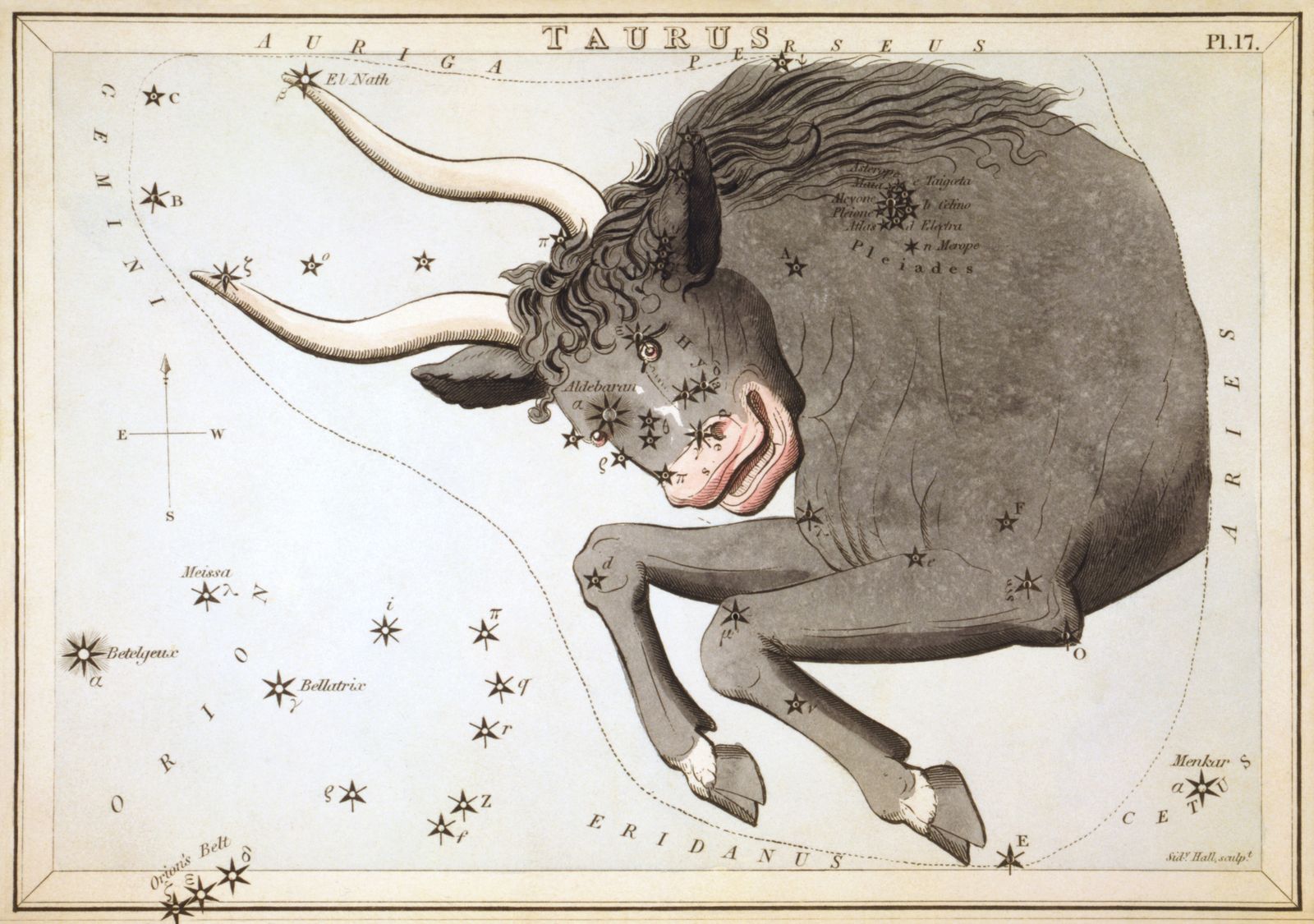
Both radiants lie in Taurus. By our calculations, the northern one is 2.2 degrees from the Pleiades and the southern one 10 degrees further south, some fifteen degrees from Aldebaran. The shower’s name expresses nothing but this perspective: the grains burn up in our atmosphere, while Aldebaran is 65 light years away and the Pleiades 444.
Comet Encke and its family
The Taurids descend from Comet 2P/Encke. Pierre Méchain first saw it on 17 January 1786, but it was Johann Franz Encke who, in 1819, computed its orbit and realised that it returns. It goes round the Sun in 3.30 years, the shortest period of any known comet according to NASA, and its nucleus is about 4.8 km across. It will next pass closest to the Sun in February 2027.
Encke is probably not alone. In 2006 Porubčan, Kornoš and Williams split the Taurid complex into fifteen filaments, using the photographic orbits in the International Astronomical Union’s database. Three of the most populated may have come from Encke. They also found possible links between seven filaments and nine near-Earth asteroids, some of which could be dormant comets or larger boulders moving within the complex.
One of them is 2004 TG10, found by the Spacewatch survey on 8 October 2004: the study ranks its link with one filament of the Northern Taurids among the four most probable associations. Its orbit resembles Encke’s, and Wikipedia cautiously says that ‘it may be a fragment of Comet Encke’. Perhaps, then, and no more than that.
Fireballs, on the other hand, can be measured. In 2015, a rich year, new digital cameras recorded 144 Taurid fireballs. In 113 of them, Spurný and his colleagues recognised a new branch whose orbits overlap the 7:2 resonance with Jupiter: seven circuits of the Sun for the grains while Jupiter completes two. Masses ranged from 0.1 gram to more than a tonne, and two asteroids 200 to 300 metres across, 2015 TX24 and 2005 UR, belong to this branch, according to the authors.
Halloween 2005 and a flash on the Moon
David Asher and Victor Clube had listed these fireball-rich years in 1993 in the Quarterly Journal of the Royal Astronomical Society, and they predicted an encounter in 2005. It came. Around Halloween, fireballs were reported from North America and the Netherlands, and astronomers, NASA reported, took to calling them the ‘Halloween fireballs’. Asher described grains ‘about the size of pebbles or small stones’ and kept expectations in check: more of a slow drizzle, ‘maybe one every few hours’.
On 7 November 2005, at 23:41 Universal Time, Rob Suggs and Wesley Swift spotted a flash in video from a telescope at NASA’s Marshall Space Flight Center in Huntsville, Alabama. Magnitude 7.3, a few degrees south of the crater Mairan. With Bill Cooke, they presented their analysis in March 2006 under a careful title: ‘A Probable Taurid Impact on the Moon’.
Assuming a Taurid grain, they arrived at a mass of about 3.8 kg and an energy of about 640 pounds of TNT, some 290 kg; the crater would be roughly 3 metres wide. No independent observation confirms the flash. The authors ruled out cosmic rays and satellite glints and speak of a probable impact. So do we.
And this year? In 2022 Lunsford announced a swarm for 2025, probably weaker than in 2022, followed by 2032, which ‘appears to be an exceptional year’; Armagh Observatory also expects the next favourable encounter in 2032. None of the sources we read makes 2026 a swarm year. So expect ordinary Taurids: a few slow meteors an hour, and a fireball if luck is on your side.
Tunguska, a hypothesis
On 30 June 1908, at around 07:14 local time, a body from space exploded in the atmosphere over Siberia, near the Tunguska river. Asteroid or comet? The question is still debated. In 1978 the Slovak astronomer Ľubor Kresák proposed a fragment of Comet Encke: the event coincides with the peak of the Beta Taurids, a daytime shower from the same complex, around 28 or 29 June. According to Wikipedia, Duncan Steel and Bill Napier have also suggested that the Beta Taurids could be the cause.
It remains a hypothesis, with serious opponents. In 1998 Zdeněk Sekanina, of the Jet Propulsion Laboratory, judged that cometary hypotheses ran into ‘unsurmountable’ difficulties and considered the fall of a small stony or carbonaceous asteroid ‘virtually certain’. As for the idea of a swarm of large objects hidden among the Taurids, Mark Boslough summed it up in 2024: ‘Most scientists remain skeptical that such a swarm exists’.
Where and when to look from Belgium
Night of 4 to 5 November, southern peak. The Sun sets at and full darkness begins at . The southern radiant has been up since , low in the east-north-east; it climbs all evening and is highest, due south, at , 54 degrees up. The Moon, a crescent 18% lit, does not rise until , in Leo, more than 110 degrees from the radiant. The best window runs from late evening to moonrise.
Night of 11 to 12 November, northern peak. The Moon, almost new, sets at , 37 minutes after the Sun: no Moon all night. Full darkness lasts from to . The northern radiant, right next to the Pleiades, culminates at , 61 degrees up. On paper, the better of the two nights, for a shower that stays thin.
In the evening the radiant is in the east: face that way, Lunsford advises. The Taurids come ‘in spurts’, so allow at least an hour, in a reclining chair, under a blanket. If the Moon is up, turn your back on it. And look for no link between the comet and the Bull of myth: the radiant lies in that constellation by perspective alone.
The 2026 Taurids in five dates
Southern Taurids peak
Radiant highest at 01:21, 54 degrees up. The Moon, 18% lit, does not rise until 03:15.
Northern Taurids peak
Moonset at 17:38: no Moon all night. Radiant highest at 01:03, 61 degrees up, 2 degrees from the Pleiades.
End of the Southern Taurids
End date in the IMO’s 2026 calendar, two months after activity began on 20 September.
The Sun enters Sagittarius
At 08:23 the Sun enters the sign of Sagittarius. The northern branch is still active.
End of the Northern Taurids
Last day of activity according to the IMO, seven weeks after it began on 20 October.
Frequently asked questions
- How many shooting stars an hour do the Taurids produce?
- About five at most, in ideal conditions: that is the zenithal hourly rate given for each branch. In practice you see fewer. The appeal lies in the slow meteors, around 28 km per second, and the rare fireballs.
- When should I watch the Taurids in 2026?
- On the night of 4 to 5 November for the southern branch, from full darkness, around 19:00, until moonrise at 03:15. On the night of 11 to 12 November for the northern branch, all night, with no Moon. Times are for Brussels.
- Where should I look from Belgium?
- Towards Taurus, near the Pleiades: in the east in the evening, due south around 01:00. The meteors can appear anywhere in the sky, but their trails seem to start from that region.
- Is 2026 a swarm year?
- No. The most recent swarm years announced were 2015, 2022 and 2025, and the next favourable encounter is expected in 2032, according to the IMO and Armagh Observatory.
- Did the Taurids cause the Tunguska explosion?
- That is a hypothesis, put forward in 1978 by Ľubor Kresák, who saw the object as a fragment of Comet Encke. It is disputed: in 1998 Zdeněk Sekanina judged the fall of a small asteroid ‘virtually certain’.
